
June 26, 2026
Advancing High-Resolution and High-Accuracy Forecasting Through the Fusion of Proprietary Data and AI



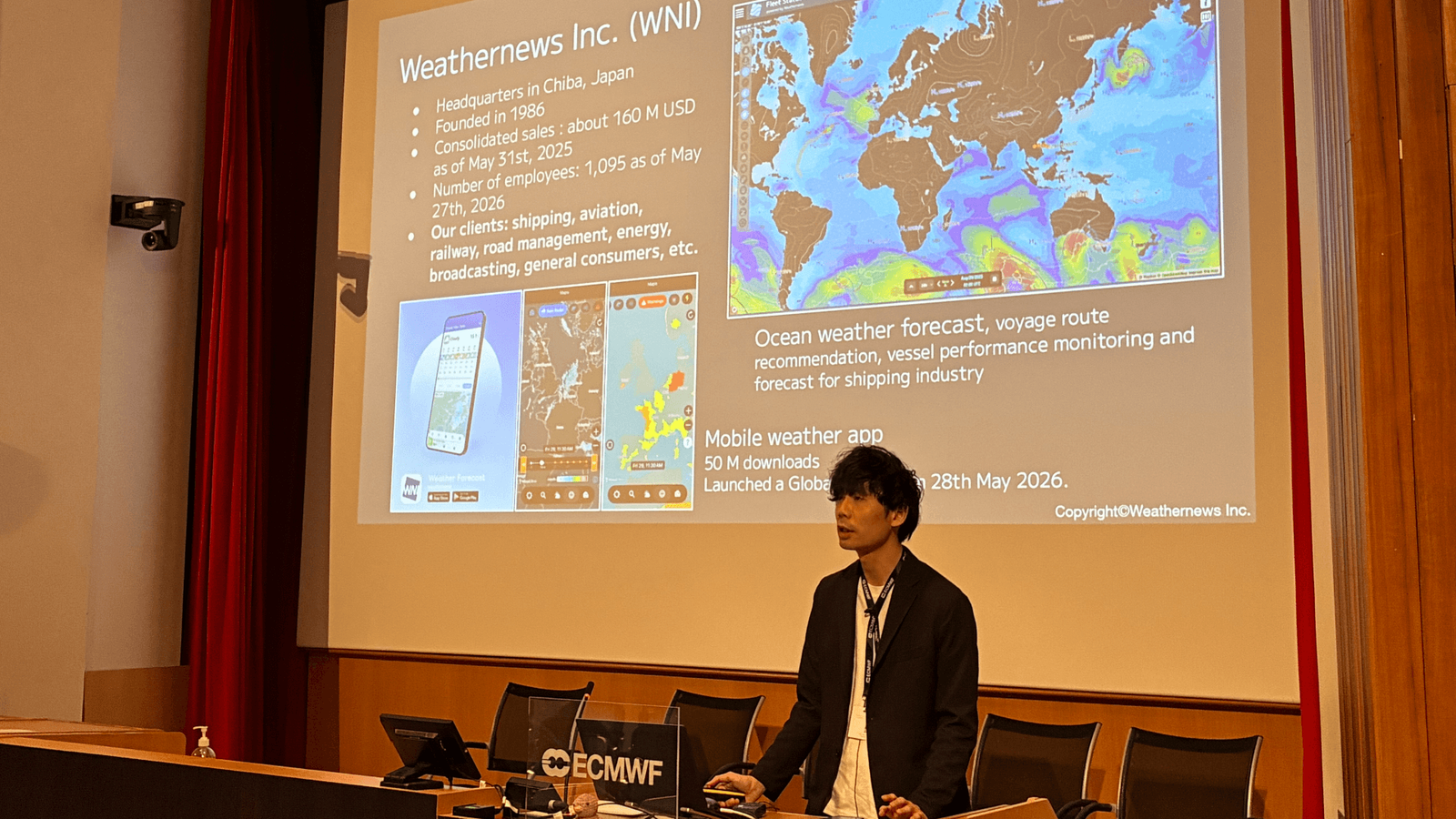
To apply the latest AI weather technologies for public safety, Weathernews participated in UEF2026, a conference held in the United Kingdom in late May 2026, marking our second consecutive year attending the event.
We sat down with Fuki Kudo and Jumpei Fujino, who presented Weathernews' AI weather prediction initiatives at the conference, to hear about their experience. In addition to sharing the company's own work showcased on stage, they offered insights into the latest AI trends shaping the meteorological industry.
What is UEF? Meteorological Experts from Around the World Gather Around the Theme of "Extreme Temperature Forecasts"
UEF (Using ECMWF's Forecasts) is an annual conference hosted by ECMWF (the European Centre for Medium-Range Weather Forecasts), a global leader in forecast technology. It serves as a valuable platform where users of ECMWF's weather prediction data from around the world come together to provide feedback to developers, exchange ideas, and share experiences with one another.
This marks the second consecutive year, and second time overall, that Weathernews has participated and presented, following UEF2025 last year.
The main theme of UEF2026 was "Extreme Temperature Forecasts." In recent years, extreme heat events such as severe heatwave damage across EU member states have become a major focus of the meteorological community.
Leveraging AI to Improve the Accuracy of High-Resolution 1 km Mesh Forecasts
In Japan specifically, temperature forecasting comes with its own unique set of challenges.
The country's intricate coastlines and mountainous terrain mean that traditional correction methods based on simple calculations (lapse rate adjustments) have historically struggled to accurately capture localized temperature variations driven by topography. Furthermore, when combining diverse weather models collected from around the world, preprocessing to unify spatial and temporal resolution is essential, yet the gains in forecast accuracy from this approach have always been limited.
To address these challenges, Weathernews developed AI downscaling technology by training a model on real observed data from our proprietary observation network. This network brings together AMeDAS readings, corporate datasets, and user-submitted reports from our app into a comprehensive 1 km mesh dataset.
Technical details are introduced in a separate blog post: https://global.weathernews.com/blog/article-2025092901/
At UEF2026, we presented verification results from two extreme heat events, showing the accuracy gains that can be achieved by combining ECMWF forecast data with AI.
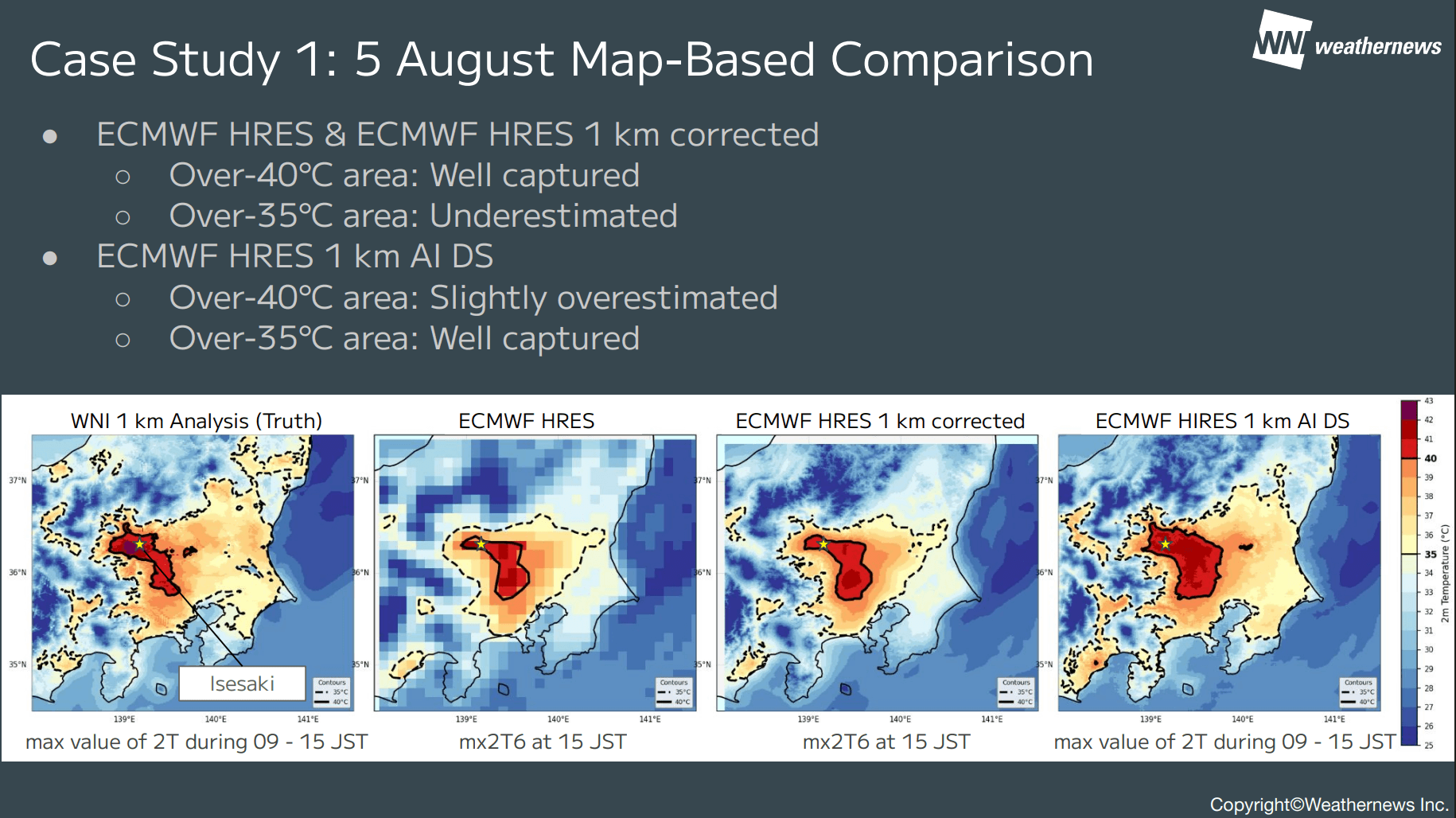
Case Study 1: August 5, 2025 / Kanto Region ** Large-scale heat wave driven by the Foehn effect**
This was the day Isesaki City, Gunma Prefecture, recorded a peak temperature of 41.8°C, caused by downslope winds from the Foehn effect combined with intense solar radiation. While conventional models underestimated the spatial extent of areas exceeding 35°C, our AI downscaling forecast captured the extreme heat zone above 35°C with high precision, resulting in a substantial improvement in forecast scores.
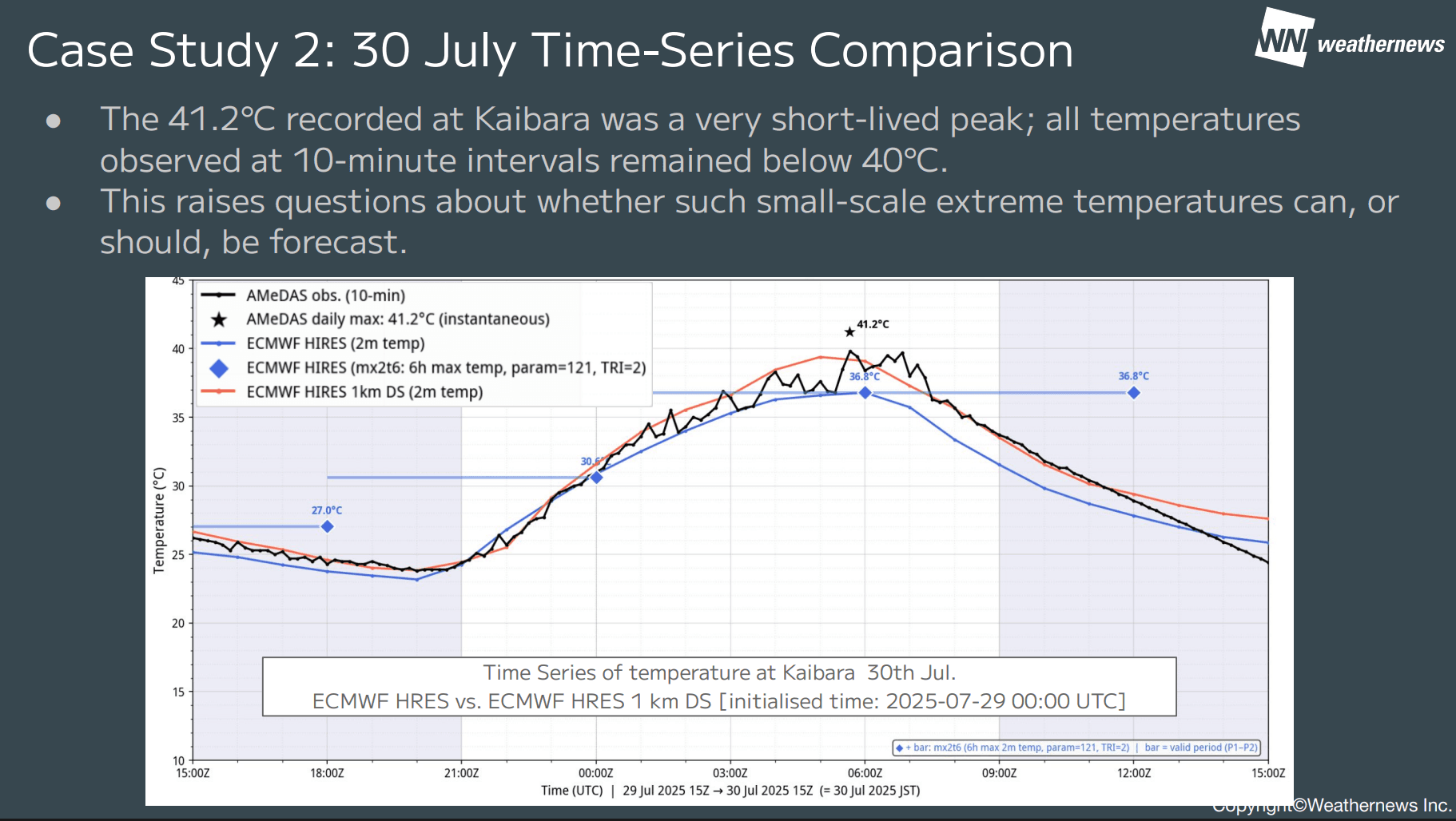
Case Study 2: July 30, 2025 / Kansai RegionLocalized extreme heat in a basin
Unlike the Foehn-driven event, this case involved heat accumulating within a small inland basin, leading to a recorded temperature of 41.2°C in Kashiwara City, Hyogo Prefecture. While AI downscaling successfully captured the high-temperature area around the basin, it struggled to accurately predict the extremely localized and short-lived temperatures exceeding 40°C. Looking at how temperatures shifted throughout the day, we also noticed a slight tendency to forecast on the high side.
The presentation is available here(Thursday, 4 June 2026)
This verification confirmed that our AI downscaling performs exceptionally well for widespread heat wave events, such as those driven by the Foehn effect during Japan's summer 2025 season. At the same time, predicting highly localized, short-duration extreme heat in basins and similar terrain remains an ongoing challenge. Weathernews will continue to refine the quality of the training data used to develop our AI, in pursuit of even more accurate forecasts.
Keeping Pace with the Latest AI Trends in Meteorology, and Contributing to a Safer Society
Weathernews is currently developing its own AI weather models that fully leverage our proprietary data. A key foundation for this work is Anemoi, an open-source framework co-developed by ECMWF and the European Meteorological Services (EUMETNET), which is rapidly becoming the de facto standard in the field.
One of our main goals in attending the event in person was to connect directly with the developers of Anemoi and those working on the next generation of AI weather models. Throughout the event, we had in-depth discussions with some of the world's leading experts in AI weather prediction, including a data assimilation specialist leading ECMWF's AI model development, as well as engineers building forecast operations and data distribution infrastructure.
We were also fortunate to hold one-on-one meetings with several AI model development teams. When we shared our concept of a new prediction model that uses user-submitted weather reports (Weather Reports) as a data source, the response was genuinely enthusiastic, especially given the uniqueness of the concept and the sheer volume of data it would bring. It was an encouraging sign for our team.
Moving forward, Weathernews plans to use Anemoi to develop a hybrid prediction model that integrates AI with existing physical models. Through this work, we aim to protect lives and livelihoods from extreme weather events, and to contribute to a safer, more resilient society.
A Travel Note: UK Weather and Our New "Global Rain Radar" in Action
Lastly, a quick word about the weather while we were there.
Late May in the UK turned out to be quite unsettled. A heatwave had just passed, the high-pressure system had weakened, and cold air had moved in overhead, so the sky was constantly changing. Showers would come and go several times throughout the day.
We took the chance to test out the brand-new "Global Rain Radar" feature in the Weathernews app during our travels. Even with the notoriously fickle British weather, it tracked the rain clouds and showers in real time without missing a beat. It was a nice reminder that our app holds up just as well on the other side of the world!

Share
October 16, 2026
Chiba Torrential Rain Disaster: How Weathernews Protected Employees and Maintained Business Continuity
September 15, 2026
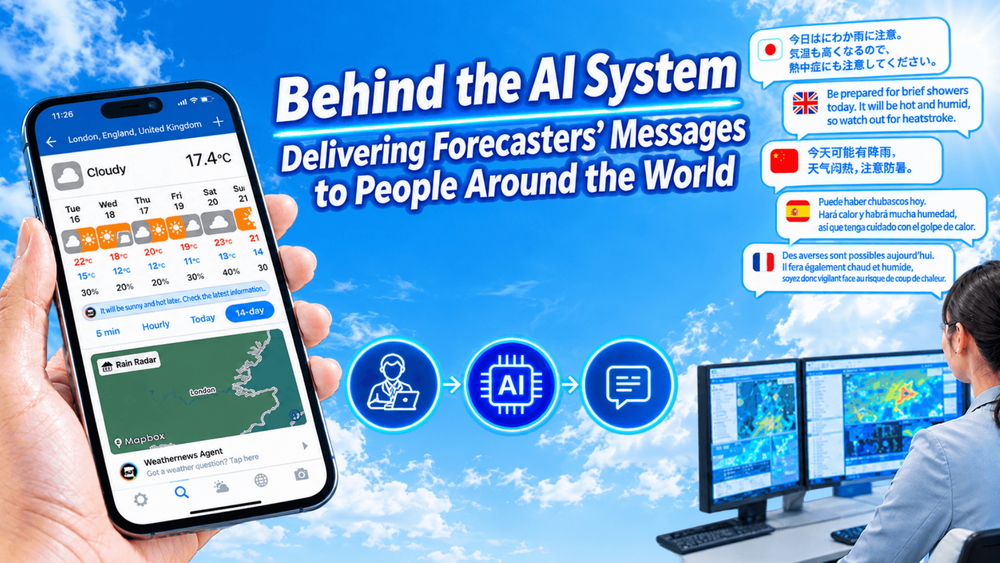
Behind the AI System Delivering Forecasters’ Messages to People Around the World in Just Three Lines
![[2026 Kumamoto Earthquake] How Weathernews LiVE Protects Lives Through User Reports and Expert Analysis](https://gvs.weathernews.jp/wni_blog_media/large_20260914_top_3958fce7fc.png)
September 14, 2026
[2026 Kumamoto Earthquake] How Weathernews LiVE Protects Lives Through User Reports and Expert Analysis