
June 4, 2026
No.1 Forecast Accuracy for Four Consecutive Years: Behind the Evaluation Process and Three Keys to Better Forecasting



Have you ever checked the forecast before heading out, only to get caught in a sudden downpour? Or changed your plans because rain was on the way, only to watch the sun shine all day?
Weather shapes countless decisions, big and small. That's why, at Weathernews, we're committed to delivering forecasts people can genuinely rely on, and why we work every single day to make our predictions more accurate.
That commitment continues to show in the results. In an independent assessment of forecast accuracy by a third-party organization, Weathernews recorded the highest annual accuracy rate among Japan's five major weather services in 2025. It's the fourth year in a row we've been recognized as Japan's most accurate forecasting service, following 2022, 2023, and 20241.
So how is forecast accuracy actually measured, and what's behind our industry-leading performance? We sat down with Mr. Unozawa of the Forecast Center to walk us through the evaluation process and the three key factors that make the difference.
A Year of Extreme Weather: The Three Keys That Kept Us No.1
For meteorologists, 2025 was an exceptionally difficult year, defined by unusual weather events. Before we get to the three keys behind our accuracy, here's a look at the two events that made the year so challenging.
Challenge 1: An Unprecedented "Dry Rainy Season"
Across western and central Japan, the rainy season started and finished earlier than at any point on record. Regions that normally see weeks of steady rain stayed remarkably dry instead, as the seasonal rain front behaved nothing like its historical patterns.
Challenge 2: A Record Year for Short-Duration Heavy Rainfall
Localized extremes, including linear precipitation bands and sudden thunderstorm outbreaks, struck again and again throughout the year. In all, Japan saw 163 issuances of "Short-Duration Heavy Rainfall Information," the highest number ever recorded. These alerts are reserved for moments when exceptionally intense rainfall poses a serious threat to life and property.
So how did we stay No.1? Three strengths made the difference.
Faced with both unusual dry spells and bursts of extreme rain, Weathernews still delivered the most accurate forecasts in Japan, thanks to three strengths that set us apart:
• More than 200,000 Weather Reports submitted by app users every day • Utilization of weather prediction models from around the world • Industry-leading 1 km mesh hyper-local forecasts
Key 1: It all starts with knowing what's happening right now.
The first step toward an accurate forecast is reading current conditions as quickly and precisely as possible. Conventional weather radar alone can't always capture the full picture. So we combine more than 200,000 daily Weather Reports from users with data from our own observation network of roughly 13,000 monitoring sites nationwide, building one of the most detailed real-time weather datasets available anywhere.
Key 2: Sharper observations make global models work harder.
That wealth of observational data is what lets us get the most out of global weather prediction models. When a model drifts too far from reality (say, in the position of a seasonal rain front), we can down-weight it or set it aside. From there, we select, fine-tune, and blend the most reliable forecasts to push accuracy as high as possible.
Key 3: Where it all comes together: 1 km precision.
Only when high-quality observations and optimized forecast models work together can we deliver our greatest strength: hyper-local forecasts at 1 km resolution. Phenomena like linear precipitation bands and sudden thunderstorms can develop over very small areas, so by calculating forecasts down to the 1 km level, we can provide weather information tailored to exactly where each user is.
In other words, the reports users send in help sharpen our forecasts, and those sharper forecasts flow right back to users as more accurate weather information. It's this continuous feedback loop that keeps Weathernews at No.1 for forecast accuracy, even as the weather grows more unpredictable.
88% Accuracy Rate: Achieving Japan’s Highest Forecast Accuracy
To hold ourselves to a clear standard, Weathernews runs its own forecast verification using the official evaluation methodology established by the Japan Meteorological Agency (JMA)2.
How Forecasts Are Evaluated
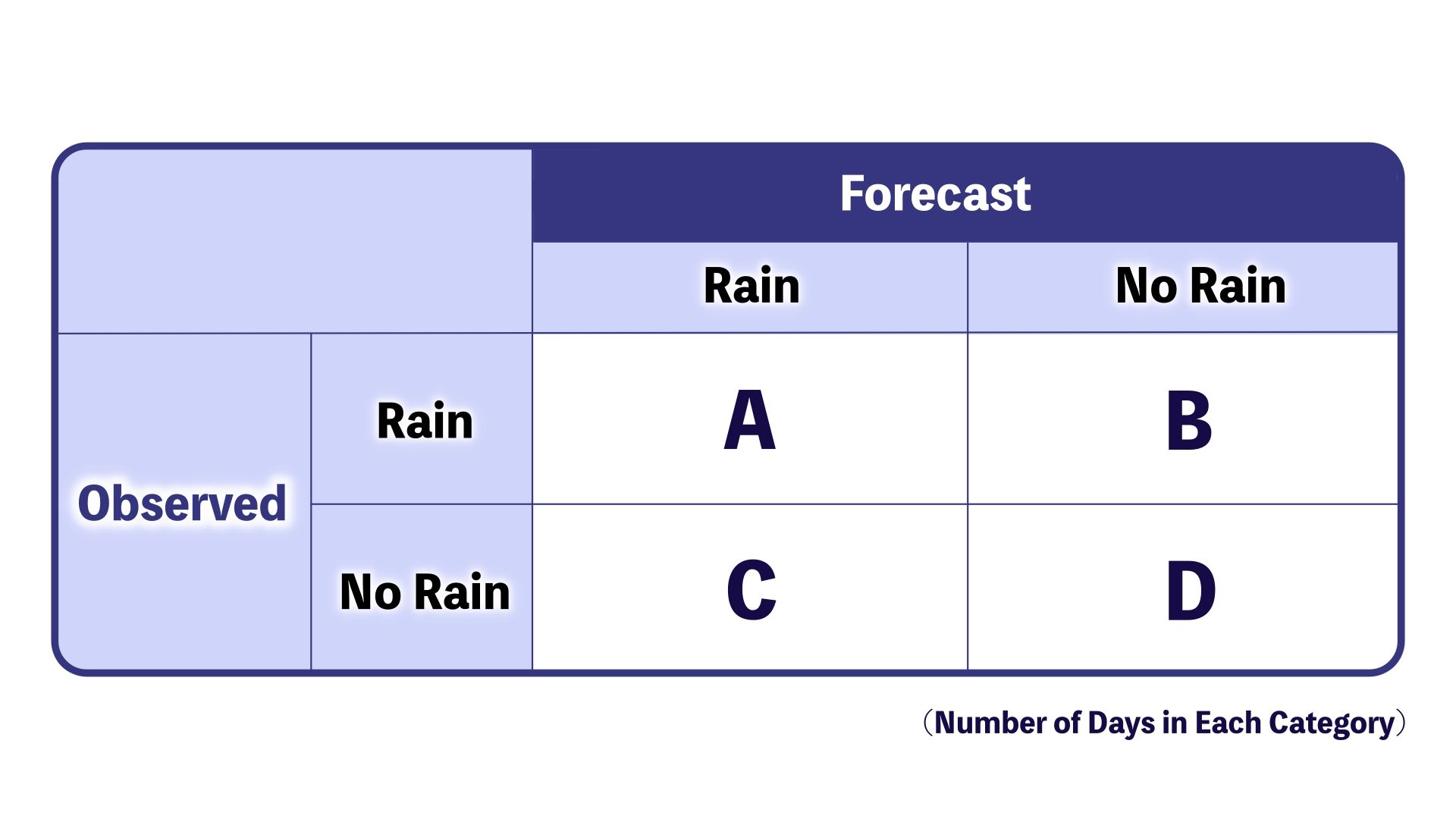
At its core, the evaluation is simple: it compares what we forecast against the weather that actually occurred.
• A = Rain was forecast, and rain occurred (correct) • D = No rain was forecast, and no rain occurred (correct) • B and C = Forecast misses — either rain we didn't predict, or rain that never came (errors)
Each day, we evaluate the forecasts issued at 5:00 a.m. using two key metrics.
1.Accuracy Rate
The Accuracy Rate is the share of all forecasts that turned out to be correct:
Correct Forecasts ÷ Total Forecasts
2. Rainfall Detection Rate
The Rainfall Detection Rate shows how reliably we caught the rain when it actually fell:
Correct Rain Forecasts ÷ Total Days with Rain
A higher detection rate means fewer missed rain events — and far fewer moments when users get caught out by rain they weren't expecting.
For verification, precipitation counts as "rain" when observed rainfall reaches 1 mm or more per hour; anything below that is treated as "no rain."
Evaluation Results
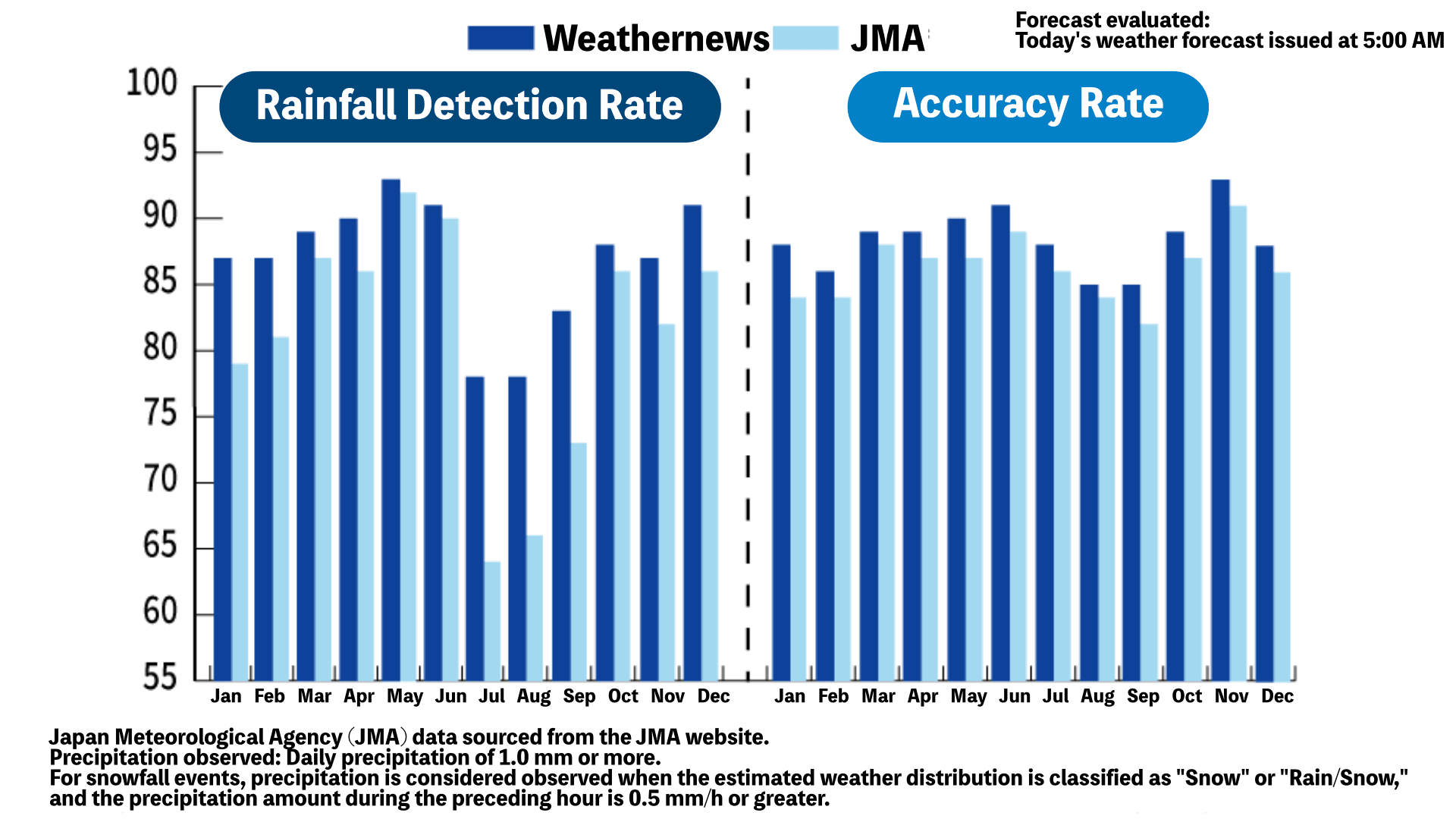
The chart below sets our forecast performance side by side with the Japan Meteorological Agency's. Across the full year of 2025 (January–December), Weathernews delivered:
• Accuracy Rate: 88%• Rainfall Detection Rate: 87%
This wasn't a one-month spike, either. Weathernews posted a higher monthly accuracy rate than the JMA in every single month of the year. In practical terms, that means we caught the rain when it came, all while avoiding false alarms about rain that never arrived. The result: forecasts that are both sensitive and dependable.
Combining User Weather Reports and AI for Even Greater Accuracy
Reaching No.1 once is an achievement. Holding onto it, year after year, is what truly earns trust.
That's why we're especially proud to have ranked No.1 for forecast accuracy in Japan four years running. And it's an achievement we could never have reached on our own. Behind it are our users, who share real-time observations every single day of conditions that conventional systems alone can't always capture.
At the same time, advances in artificial intelligence are opening up new ways to push forecasting technology forward. We've already started putting AI to work, analyzing the Weather Reports our users submit and strengthening the way our forecasts are generated. Together, these efforts are helping us take yet another step toward even greater accuracy.
As weather forecasting evolves, so does Weathernews. With the continued support and trust of our users, we will keep delivering ever more advanced weather intelligence, not just for Japan, but for people all around the world.
Footnotes
Share
October 23, 2026
【Behind the Scenes of the 2026 Aichi-Nagoya Games】What Kind of Weather Information Is Being Used to Ensure the Safety of Staff and Athletes from 45 Countries and Regions?
October 16, 2026
Chiba Torrential Rain Disaster: How Weathernews Protected Employees and Maintained Business Continuity
September 15, 2026
Behind the AI System Delivering Forecasters’ Messages to People Around the World in Just Three Lines