
May 13, 2026
Meteorological Factors Behind the Large-Scale Expansion of the Otsuchi Wildfire (April 2026) | Weathernews Independent Analysis



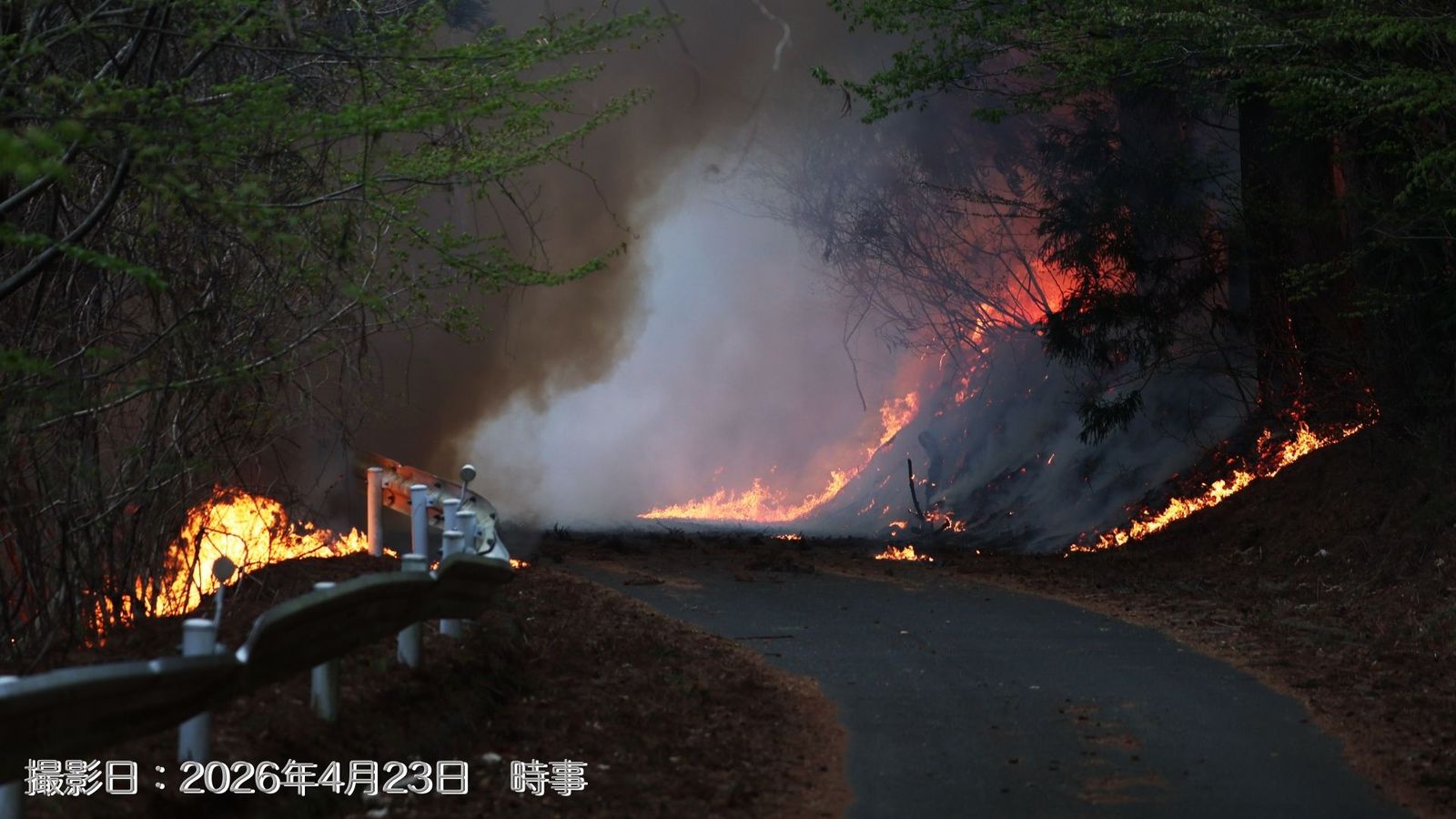
On April 22, 2026, a large-scale wildfire broke out in Otsuchi Town, Iwate Prefecture, causing extensive damage to surrounding areas. We extend our heartfelt sympathies to all those affected and to the residents who were forced to evacuate. We also express our deepest respect and gratitude to the firefighters, Self-Defense Forces personnel, and everyone involved in round-the-clock firefighting operations.
Wildfires are a serious and often underestimated risk for municipalities with mountainous terrain and for companies operating infrastructure near forested areas. In this article, we analyze the meteorological conditions that allowed this fire to grow to such an extraordinary scale, and introduce measures that can help minimize damage in the future.
Damage Overview: The Otsuchi Wildfire (April 2026)
The wildfire that broke out in Otsuchi Town on April 22 spread rapidly, driven by strong winds and extremely dry conditions. Within days of ignition, the burned area exceeded approximately 1,600 hectares, making it the second-largest wildfire in Japan since the beginning of the Heisei era (following the 3,370-hectare fire in Ofunato City, also in Iwate Prefecture, in February 2025).
After continuous firefighting efforts, the town declared the fire "contained" on May 2, the 11th day after the outbreak.
The fire devastated not only forested areas but also land near residential districts, including the coastal Kirikiri district. At its peak, evacuation orders were issued for 1,558 households and 3,257 residents.1
The fire also spread close to television and FM radio relay stations, raising concerns about potential broadcasting disruptions and impacts on critical social infrastructure.
Weathernews Analysis: Why Did This Fire Spread So Rapidly?
The primary reason this wildfire grew into the second-largest since the Heisei era was a combination of meteorological conditions that strongly promoted both ignition and fire spread.
Extreme Dryness from the Foehn Effect (Humidity as Low as 8.7%)
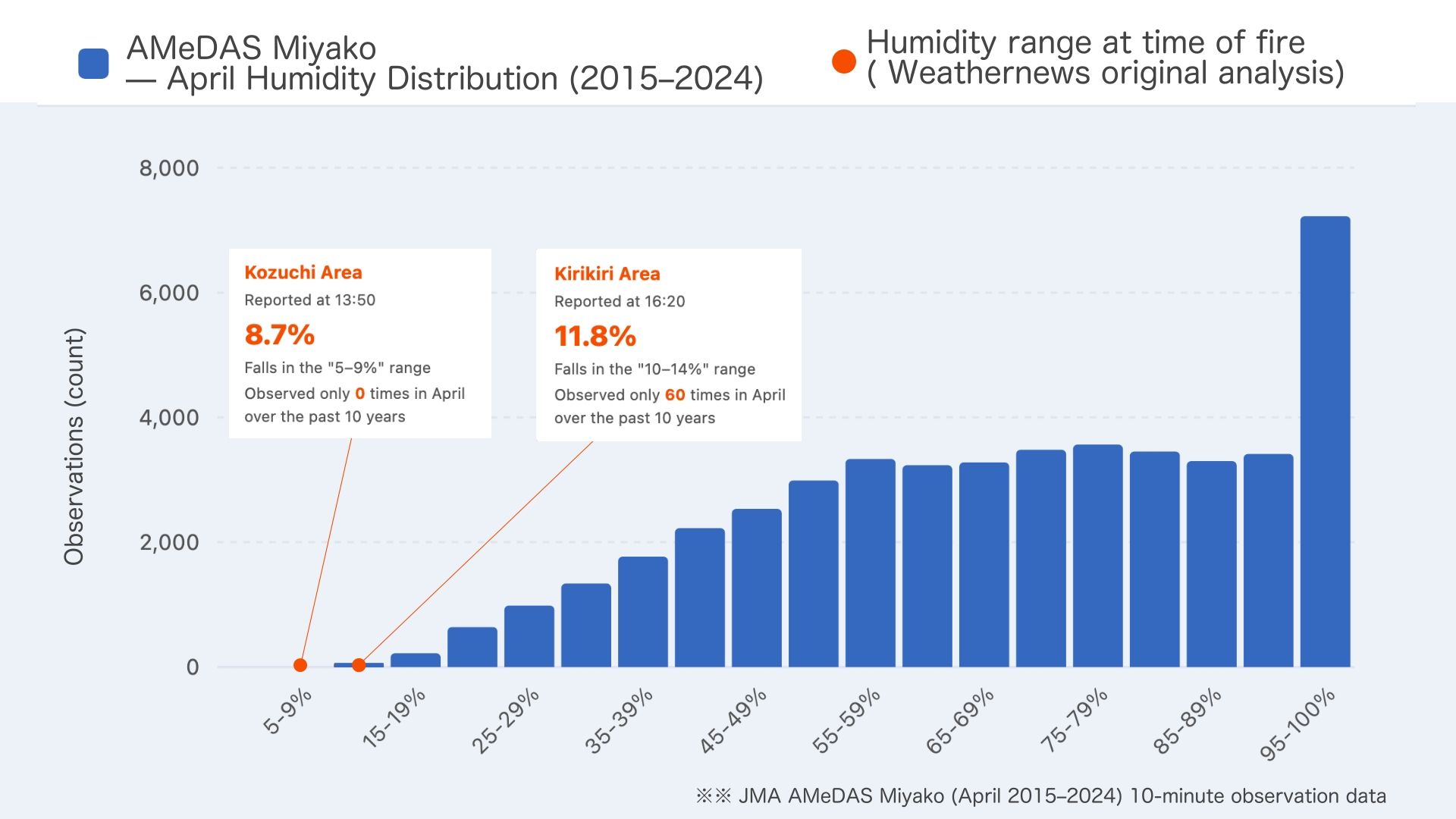
Due to the foehn effect and related atmospheric dynamics, conditions were extraordinarily dry. According to Weathernews' proprietary analysis data, humidity at the time of the fire was just 8.7% in the Kozuchi area and 11.8% in the Kirikiri area.
At these levels, even a small ignition source can easily spark a fire that spreads rapidly through fallen leaves and dry vegetation on the forest floor.
Strong Westerly Winds
At the time of the outbreak, strong winds were blowing continuously from inland areas toward the coast. Wind speeds reached 9.4 m/s in Kozuchi and 8.3 m/s in Kirikiri.
These westerly downslope winds, blowing from the mountains toward the sea, intensified the flames and significantly accelerated the fire's rate of spread.
No Rainfall to Help Suppress the Fire Naturally
Rain is the most effective natural factor in suppressing wildfires. However, no rainfall occurred for several days after the outbreak, and worsening conditions (including strengthening winds toward the weekend) contributed to prolonged and widespread damage.
Later, at 6:00 PM on May 1, rainfall of 32 mm/hour was observed in the Kirikiri area and 14 mm/hour in the Kozuchi area, supporting firefighting efforts and helping bring the fire under control.
Two Separate Fires on the Same Day: Were They Connected?
Once a wildfire breaks out, even a small ignition source can spread rapidly under prolonged dry conditions and develop into a large-scale fire.
Although two fires occurred on the same day, it is unlikely they were directly connected through mechanisms such as flying embers. The Kozuchi area, where the first fire broke out, is located approximately 10 km from the Kirikiri area, where the second fire later occurred. Given the wind conditions at the time, it is difficult to conclude that embers from Kozuchi traveled as far as Kirikiri.
Wildfire Countermeasures and Forecasting Technologies for Municipalities and Businesses
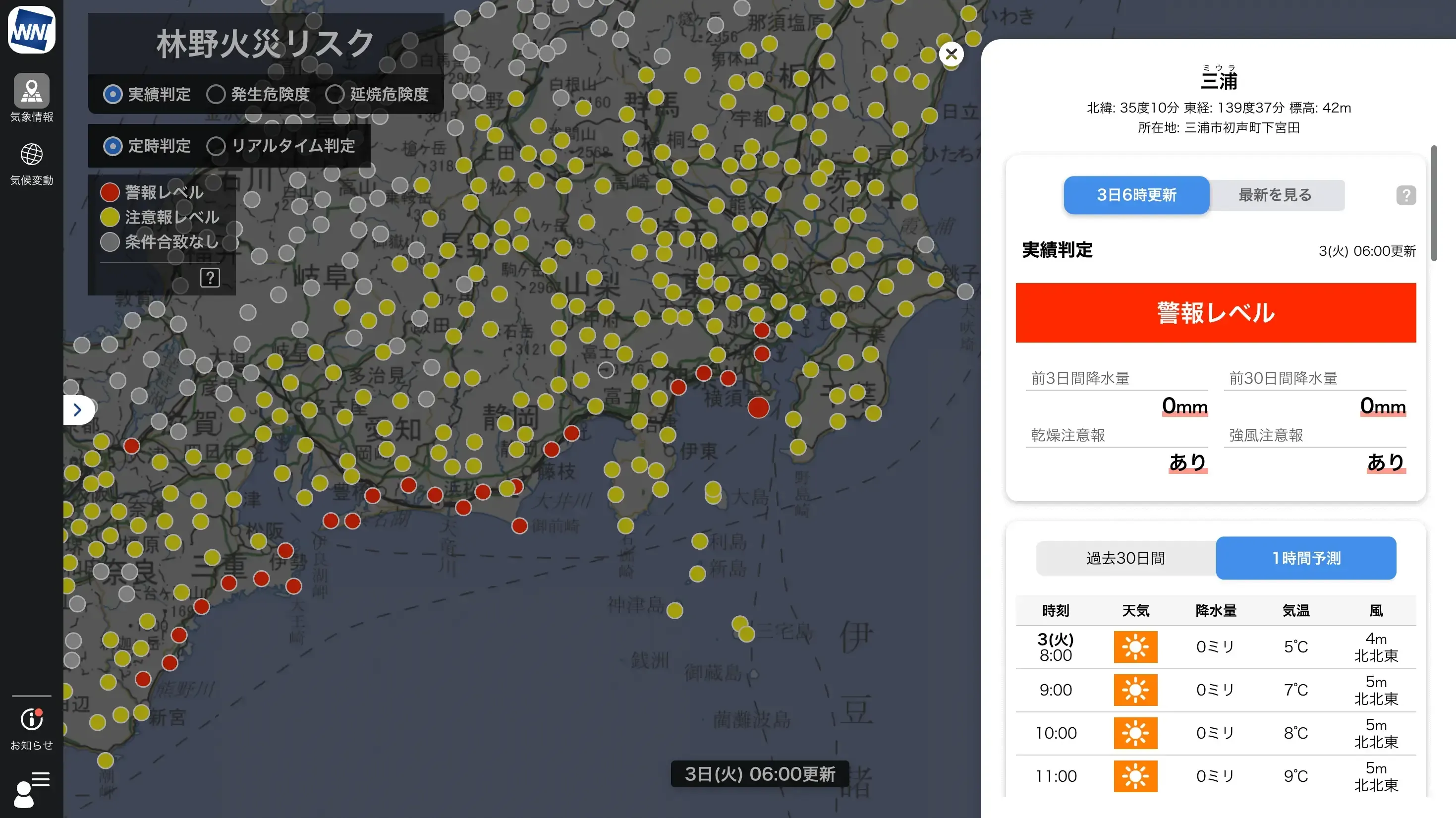
To protect local residents and valuable assets from wildfires, it is essential to assess risks in advance based on weather conditions and respond quickly during the initial stages of a fire. Weathernews provides wildfire countermeasure services for municipalities and businesses through "Weathernews for Business."
The service automatically evaluates wildfire warning and advisory conditions based on criteria published by Japan's Fire and Disaster Management Agency, helping organizations accelerate decision-making when it matters most.
In addition, users can monitor wildfire ignition risk forecasts up to 72 hours ahead using Weathernews’ proprietary weather prediction technology, as well as fire spread risk forecasts based on the latest wind direction and wind speed data. These tools support more effective firefighting operations and safer evacuation route planning.
関連リンク
・Mt. Ogi Wildfire: Long-Term Firefighting Expected as Burned Area Exceeds 200 Hectares](https://jp.weathernews.com/blog/article-2026011601/)
Footnotes
Share
October 16, 2026
Chiba Torrential Rain Disaster: How Weathernews Protected Employees and Maintained Business Continuity

September 15, 2026
Behind the AI System Delivering Forecasters’ Messages to People Around the World in Just Three Lines
![[2026 Kumamoto Earthquake] How Weathernews LiVE Protects Lives Through User Reports and Expert Analysis](https://gvs.weathernews.jp/wni_blog_media/large_20260914_top_3958fce7fc.png)
September 14, 2026
[2026 Kumamoto Earthquake] How Weathernews LiVE Protects Lives Through User Reports and Expert Analysis