
September 15, 2026
Behind the AI System Delivering Forecasters’ Messages to People Around the World in Just Three Lines



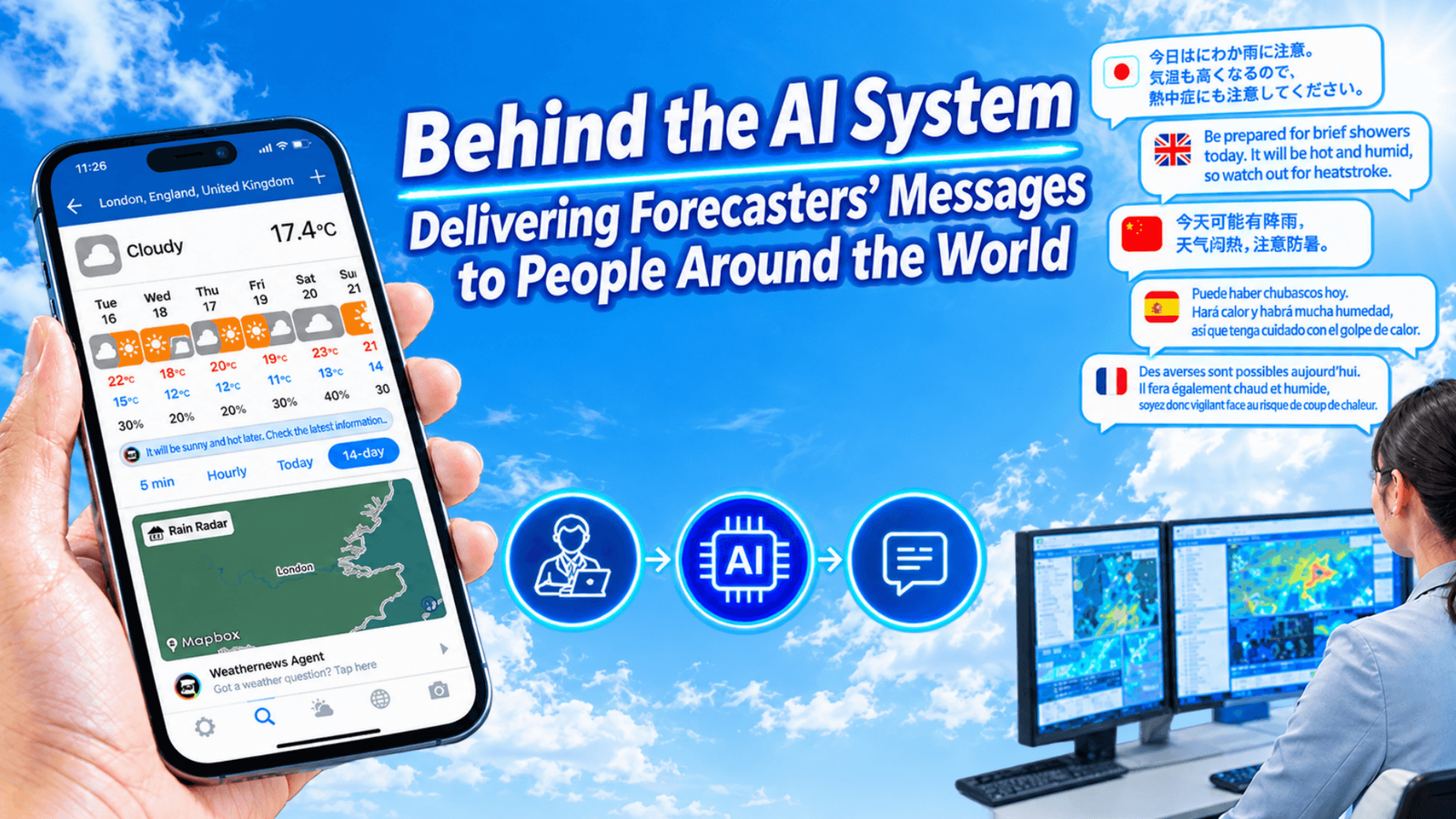
"Please watch out for sudden showers today. It will become hot and humid, so take precautions against heatstroke." "There is a risk of thunderstorms. If you hear a rumble, please take temporary shelter from the rain."
When you open our weather app, these brief messages might catch your eye. They may look simple at first glance, but these comments are packed with the strong dedication of professional meteorologists who care deeply about the daily lives and safety of our users.
In fact, until just a few years ago, our staff wrote these comments entirely by hand. However, once the decision was made to expand the app globally, we decided to step away from manual creation and transition to an AI-powered system.
Could we logically translate the deep care our meteorologists put into these weather comments into a system and reproduce it faithfully? Could we control the rising costs associated with supporting multiple languages and handling a vastly expanded volume of data? We asked Haruna Ikemori and Ayaka Suitsu from the Forecast Center’s development team about the untold behind-the-scenes challenges of this project and the path they took to solve them.
The Dedication Meteorologists Put Into "Weather Commentary" to Support Daily Life and Protect Safety
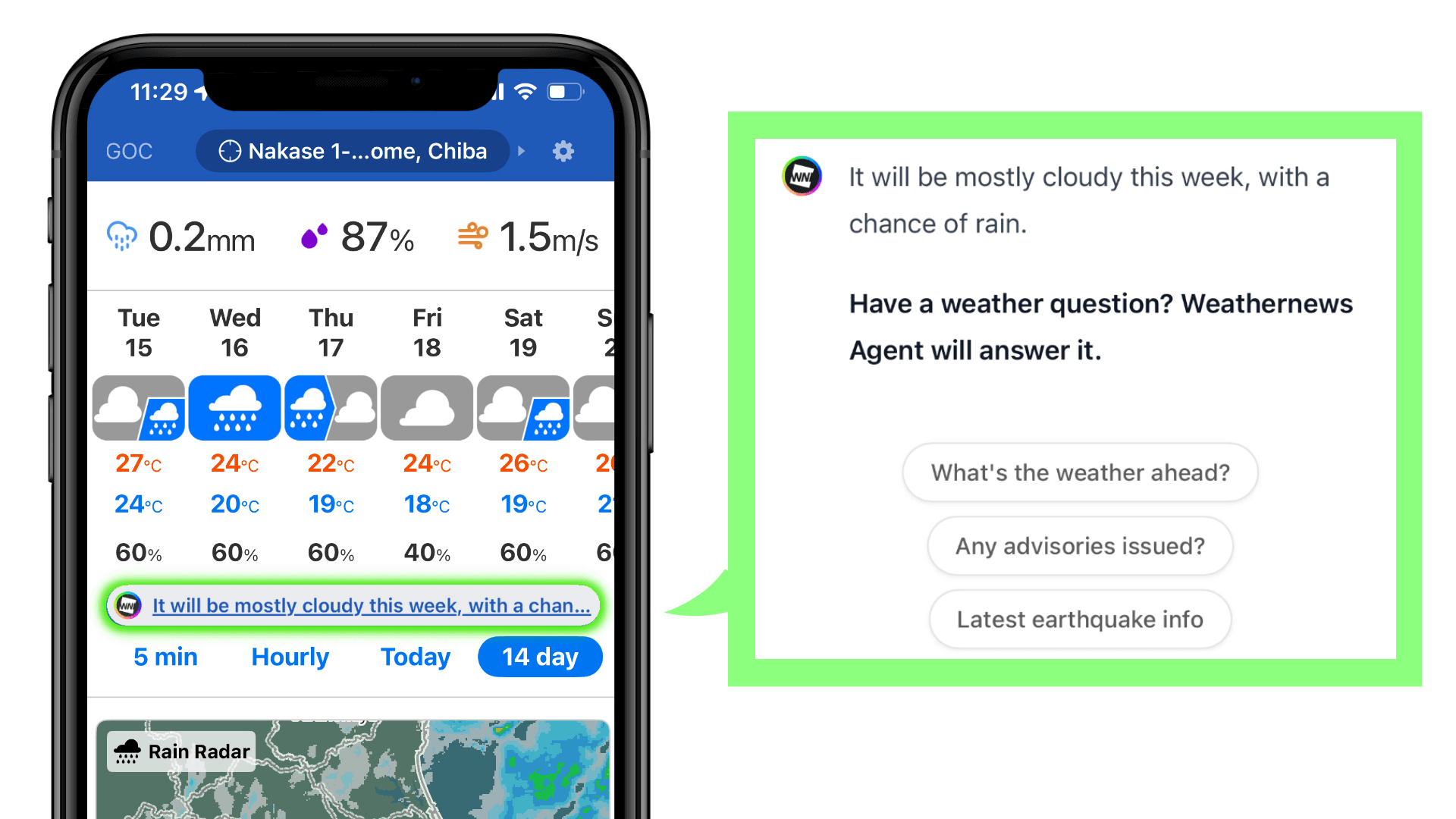
When people think of a weather forecast, many might simply picture weather icons showing sunshine or rain. At Weathernews, however, we have always maintained a strong commitment to going beyond merely reporting the weather. We insist on delivering actionable advice that explains exactly what people should do in response to those conditions. The reason for this is simple. We want to convey how the weather will actually impact daily life, something that raw data alone cannot fully communicate. Instead of just stating the meteorological phenomenon of "rain," we want to advise that "an umbrella is necessary." Rather than just giving a numerical value like "35°C," we want to urge people to "take precautions against heatstroke." Our goal is to deliver information that prompts users to take specific actions.
When the decision was made to make the Weathernews app available worldwide, we repeatedly discussed how we could deliver this kind of weather commentary to users across the globe.
With the entire world as our target, it became physically impossible for human staff to monitor global weather and write comments manually. Even if it were possible, our limited resources would force us to lower the resolution of the information we provide. That would mean sacrificing the very thing we value most: information that truly supports our users.
Therefore, we decided to develop a system centered around AI. In just a few months, we built an AI system capable of providing weather commentary for hyper-local forecasts all over the world. The number of locations it covers reaches an astonishing 70 million.
Expertise Forged in Japan’s Complex Climate Becomes Our Global Foundation
As we moved forward with utilizing AI for weather commentary, concerns naturally arose. People worried if the text would become mechanical and impersonal, or how we would prevent the risk of hallucinations where the AI generates false information. To eliminate these concerns, we developed our own proprietary AI system built entirely on our internal AI expertise and our years of operational know-how in creating weather commentary.
A Standard Model for Global Expansion This model takes in time-series data such as the sequence of weather icons, wind speed, precipitation amounts, and precipitation phases (the transition between rain, snow, and sleet). It then generates natural sentences tailored to the specific situation.
An Advanced Control Model for Japan This model incorporates more than 10 different elements, including perceived temperature, day-over-day changes, and road surface conditions. It features an advanced control logic that dictates the priority of information directly linked to user safety, such as prioritizing warnings for heavy rain and landslides over strong winds. Japan features complex terrain, rapidly changing weather, and frequent typhoons and heavy rainfall every year. Operating in this severe environment, we have spent years sharpening our judgment regarding which information must be communicated first to protect people's lives and livelihoods.
At first glance, this might look like just a cutting-edge AI system, but the true key to its success is the human expertise we have cultivated over decades. The logic for prioritizing life-saving information, refined through years of experience in Japan, now serves as the AI's core engine. It provides the solid foundation needed to support 70 million locations worldwide.
Updating 70 Million Locations Every Hour? An AI Design That Balances Quality and Cost

To ensure we are always delivering the latest weather conditions, the weather commentary is updated every single hour. The system automatically handles time zone differences and daylight saving time. Furthermore, whenever the underlying weather forecast models are updated, the comments for the entire world are refreshed simultaneously. This strict control ensures there are absolutely no discrepancies between the weather icons displayed on the screen and the written commentary.
However, using AI to generate real-time comments for 70 million locations every hour would require enormous processing costs and place a massive load on our servers. To solve this, rather than having the AI read the data and generate text for every location from scratch every time, we pre-generated and prepared comments based on specific weather patterns.
By designing the system to instantly retrieve the optimal comment for a specific weather pattern the moment a user opens the app, we successfully maintained high quality and rapid response times while keeping processing costs as low as possible.
There are currently 6,200 of these patterns. To address recent global social issues like extreme heat, we are in the process of expanding this to approximately 12,000 patterns. By fusing cutting-edge AI technology with specialized meteorological expertise, we are achieving a high level of both quality and cost efficiency while delivering messages that protect lives around the world.
Can Weather Commentary Support Users Worldwide Across Language and Cultural Barriers?

Pivoting from an app for Japanese users to a globally available service required us to implement multi-language support. Behind the scenes, we faced language and cultural barriers that could never be solved by simple translation alone.
For example, a very common and natural phrase in Japanese translates literally to 'blue skies will spread.' To an English speaker, this sounds awkward and doesn't make much sense for a weather forecast. To eliminate this kind of unnatural phrasing, we combine feedback from native-speaking employees with AI-driven checks to ensure the text reads perfectly in every language.
Currently, weather commentary is created in multiple languages, including English, French, Portuguese, and Indonesian. By translating these based on the user's selected language settings in the app, we ultimately support display in 57 languages. We are also developing support for three additional languages: Spanish, Korean, and Chinese (with separate support for Traditional and Simplified characters), which are scheduled for release soon.
Beyond language, differences in perception and culture present a major challenge. The Japanese version incorporates highly detailed expressions of perceived temperature, such as "muggy" or "chilly." However, even at the same 35°C (95°F), how people experience that heat varies drastically depending on the region and local climate. Introducing perceived temperature expressions into the global version, adapting to region-specific weather phenomena like squalls and dust storms, and reflecting cultural differences like regions where people do not have the custom of using umbrellas when it rains, are all challenges we will tackle next.
We want to deliver the words that feel the most accurate and natural for the sky directly above each individual user, no matter where they are in the world. Our updates to support users' daily lives will continue.
What used to be a service limited to Japan, with dedicated staff manually writing out messages for one location at a time, has undergone a massive evolution into an AI system covering 70 million locations worldwide with the global app release in August 2026. Naturally, global weather commentary is still in the middle of its evolution, especially regarding detailed perceived temperature expressions for different regions and adaptation to cultural differences.
Even so, the knowledge for protecting human lives and livelihoods that we have cultivated over many years in Japan holds an unchanging value for users all over the world.
We must ensure that tailored information and weather disaster warnings reliably reach people across the globe. We believe that this commitment is the key to earning the solid trust of each individual and evolving our app into an indispensable presence worldwide. With that belief, we will continue to update and improve our service.
Share
October 23, 2026
【Behind the Scenes of the 2026 Aichi-Nagoya Games】What Kind of Weather Information Is Being Used to Ensure the Safety of Staff and Athletes from 45 Countries and Regions?
October 16, 2026
Chiba Torrential Rain Disaster: How Weathernews Protected Employees and Maintained Business Continuity
![[2026 Kumamoto Earthquake] How Weathernews LiVE Protects Lives Through User Reports and Expert Analysis](https://gvs.weathernews.jp/wni_blog_media/large_20260914_top_3958fce7fc.png)
September 14, 2026
[2026 Kumamoto Earthquake] How Weathernews LiVE Protects Lives Through User Reports and Expert Analysis