
March 16, 2026
Japan's Most Comprehensive Cherry Blossom Forecast



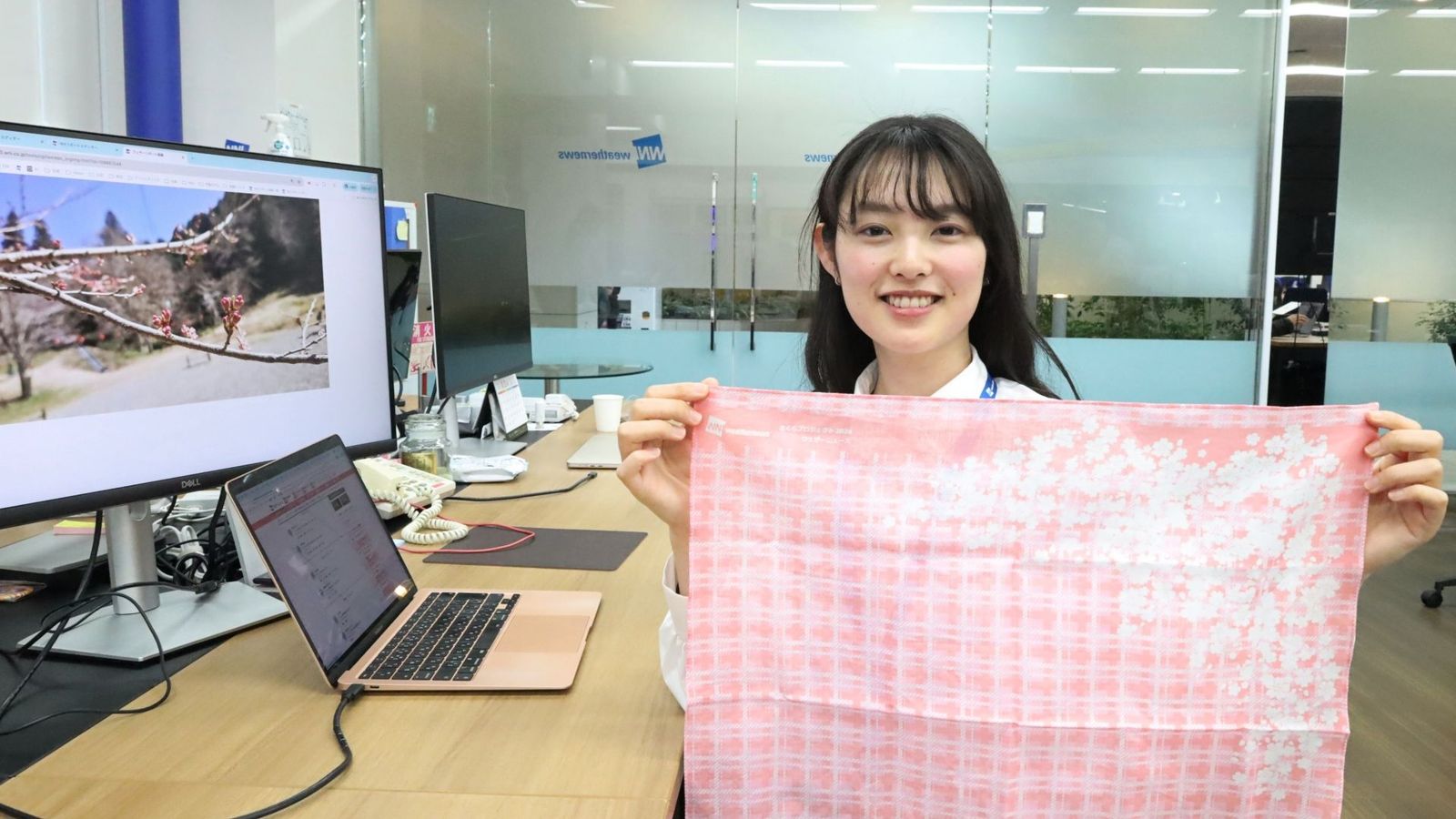
Cherry blossoms herald the arrival of spring throughout Japan. While early-blooming varieties have already transitioned from full bloom to vibrant green foliage, we're now entering the season when anticipation builds for the flowering of the beloved Somei-yoshino cherry trees.
According to the latest forecast from Weathernews, this year's first cherry blossoms in Japan are projected to bloom in Tokyo on March 19, indicating an earlier-than-usual spring arrival.
The cherry blossom forecasts developed by Weathernews extend beyond traditional meteorological calculations. They're enhanced by our "Sakura Project"—a collaborative initiative involving our nationwide app users who document individual cherry trees throughout their lifecycle, from budding through full bloom to the emergence of green leaves.
How does Weathernews achieve such precise bloom date predictions across 1,400 locations nationwide? In this article, we explore the innovative forecasting methodology that sets Weathernews apart.
Crowdsourced Cherry Blossom Forecasting — Powered by Over 2 Million "My Sakura" Photo Submissions
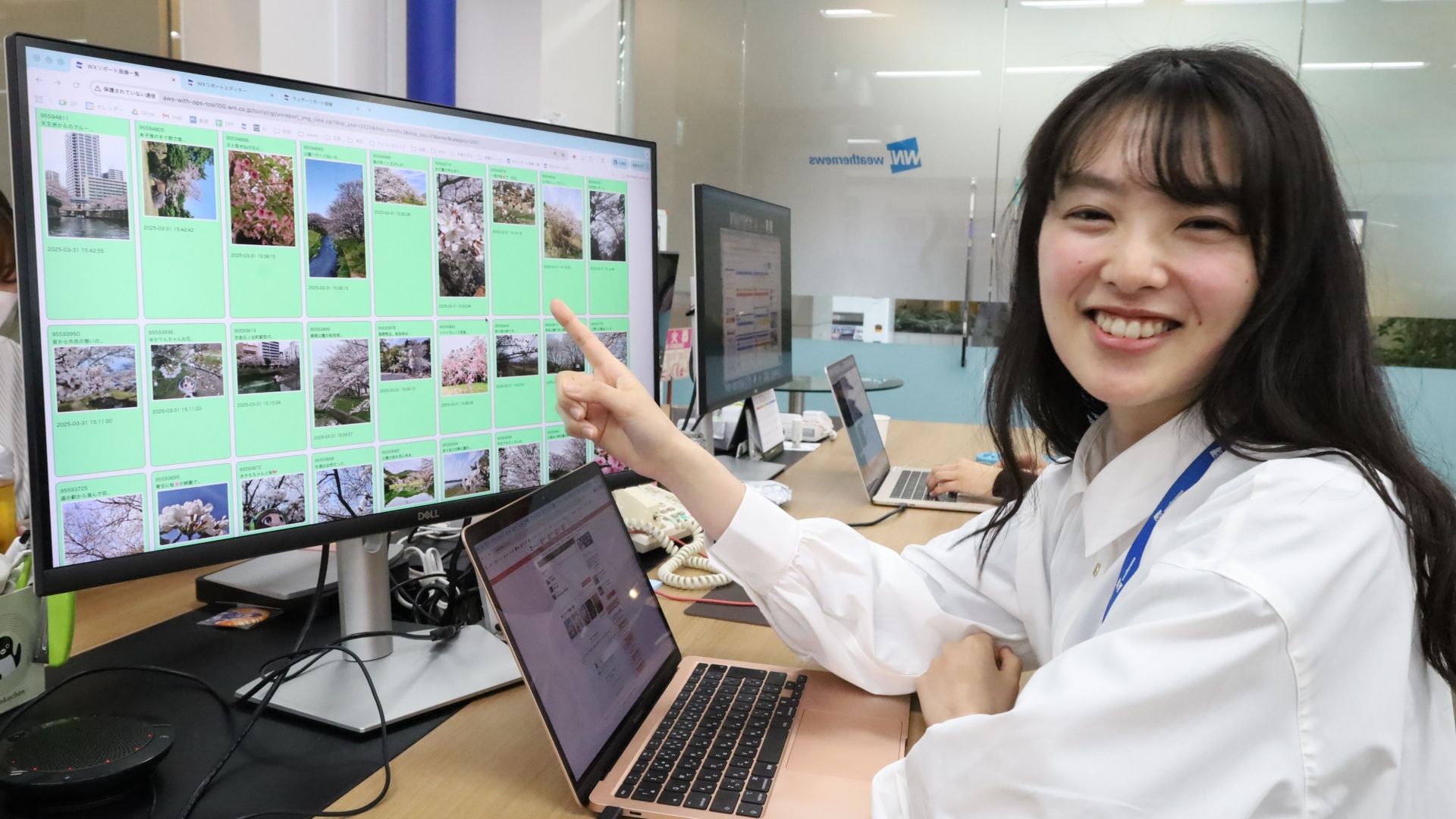
A cornerstone of the Weathernews bloom forecast is our "Sakura Project," a participatory initiative running continuously since 2004.Through this program, app users nationwide register nearby cherry trees as their personal "My Sakura" and provide ongoing status updates—tracking progression from swelling buds through flowering to the emergence of green leaves.
To date, we've received more than 2 million user reports, creating a robust dataset that serves as the backbone of our bloom forecasting system. While most cherry blossom forecasts rely primarily on historical temperature data and meteorological modeling, Weathernews takes a hybrid approach by integrating these calculations with real-time bud condition data collected across the country.
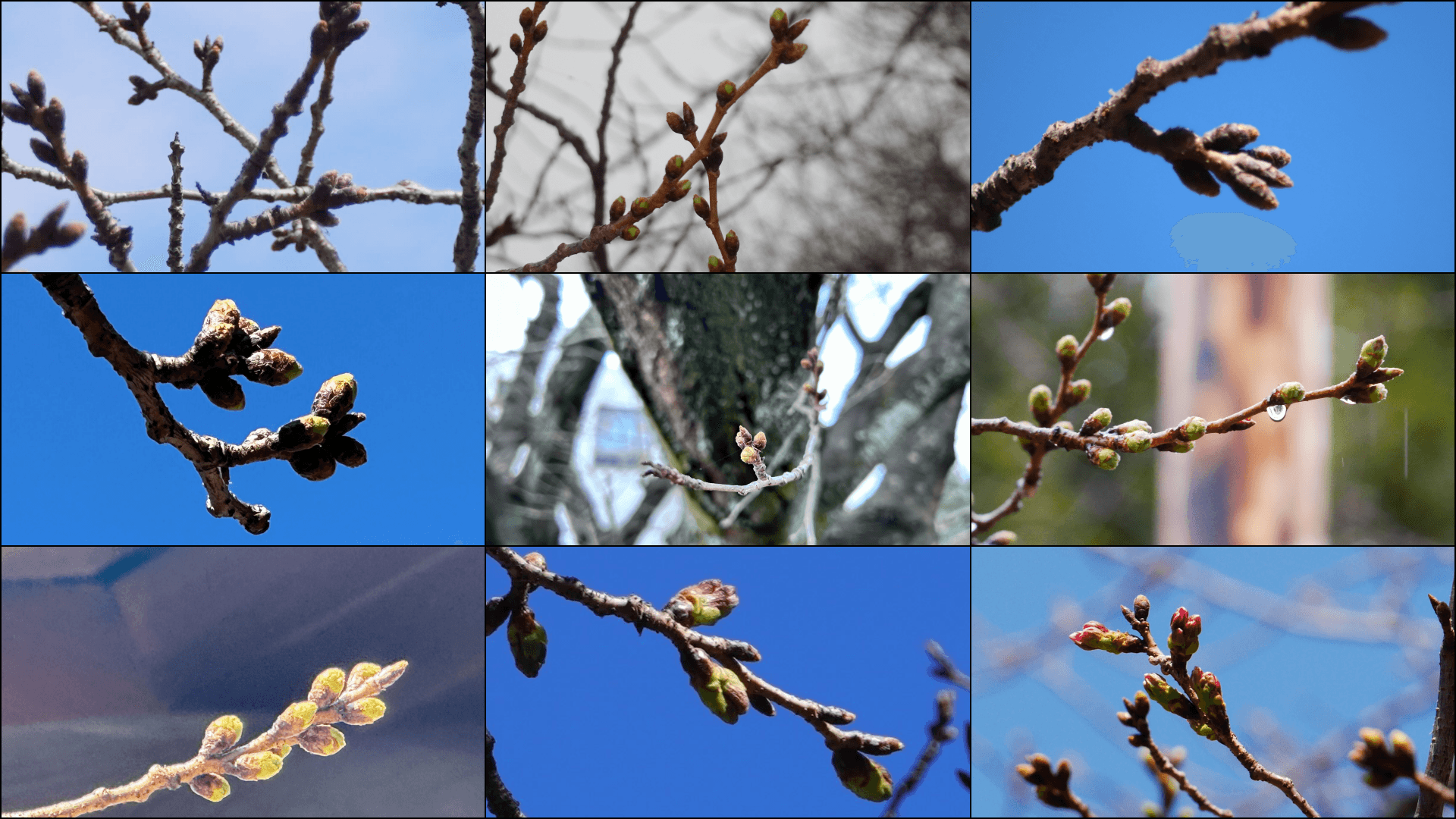
User-submitted photos enable us to calibrate for subtle variations—for instance, when predictive models indicate a certain growth stage but actual buds show more advanced development. Our AI technology analyzes these images to precisely assess bud development stages, ensuring forecasts reflect actual tree conditions rather than theoretical projections.
Beyond our user community's contributions, Weathernews meteorologists conduct rigorous field observations. Beginning approximately one month before expected bloom dates, our weather professionals perform daily monitoring of designated "sample trees."
As the blooming season approaches, our Tokyo-based team members rotate responsibility for daily observation of bud tips on the city's sample tree, meticulously documenting even minor changes. These findings are shared daily across the organization via our internal collaboration platform.
Real-time updates such as "Bud tips have developed pink coloration!" or "Blooming appears imminent!" are posted as conditions evolve. These updates engage not only our forecasting team but also colleagues across sales, development, and other departments who collectively anticipate the cherry blossom season.
Forecasting Bloom Dates at 1,400 Locations Through Proprietary Methodology Integrating User Photography and High-Precision Data
Weathernews publishes granular cherry blossom bloom forecasts for approximately 1,400 sample trees and renowned viewing locations nationwide. Our predictions are driven by three core factors:
• Temperature trends • Dormancy break timing • Real-time observations of cherry buds
First, temperature trends are crucial. When blooming is more than two weeks away, forecasts rely predominantly on long-range average temperature projections. As bloom dates near, our meteorologists analyze daily weather patterns with particular focus on average and maximum temperatures.
For instance, during Tokyo's 2025 season, warm March conditions accelerated bud development.
However, a cold spell immediately preceding bloom prompted a forecast revision. Even with advanced bud development, temperature fluctuations in the days before blooming can significantly impact timing—making pre-bloom temperature monitoring essential.
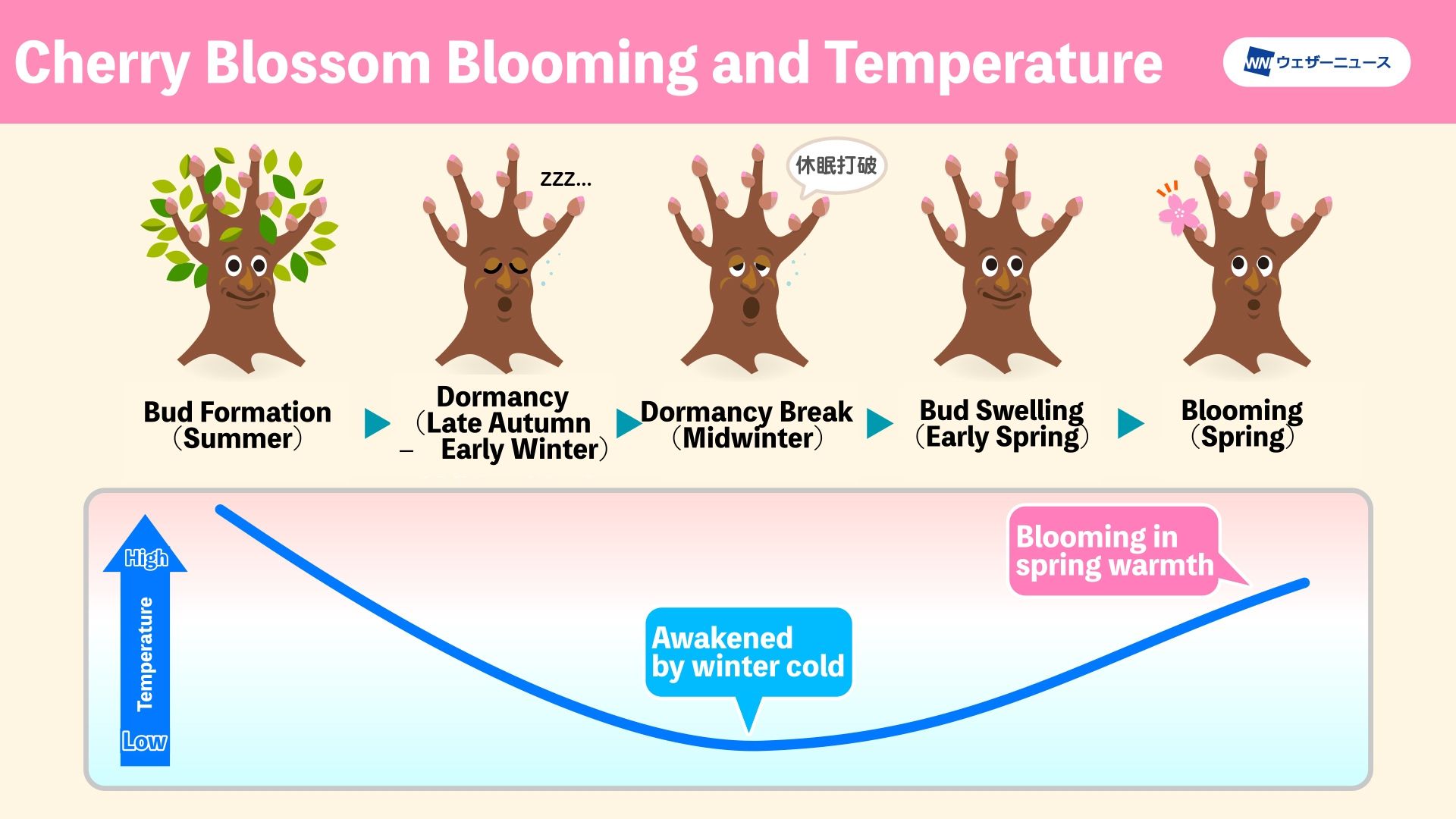
The second key factor is the timing of “dormancy release.” Cherry tree buds require adequate winter chilling before initiating spring growth. This cold exposure acts as a biological trigger enabling progression toward bloom.
Notably, the temperature thresholds for dormancy break vary by region.
Along the Sea of Japan coast, frequent winter cold air masses typically facilitate earlier dormancy break. Conversely, Pacific coastal areas experiencing milder winters may see delayed triggering. In locations like Kagoshima, this means that even with rising pre-bloom temperatures, actual flowering may still lag behind expectations.
Consequently, we analyze temperature patterns from late autumn forward in each region to determine dormancy break status.
The third factor is the direct observation of buds mentioned earlier.
Weathernews validates calculated bloom dates against actual conditions by integrating employee sample tree monitoring with user-submitted cherry blossom photography from across the country. By cross-referencing current bud status with the latest meteorological data, we continuously refine forecasts to align with ground conditions.
This comprehensive process culminates in our final cherry blossom bloom forecast. We also spoke with Arioka, the cherry blossom specialist at the Weathernews Forecast Center.
(Comment from Arioka, Forecast Center) “After observing cherry blossoms for many years, you begin to notice many unique characteristics of each tree.
Some of the official ‘sample trees’ used for observation across Japan are quite old, and aging trees tend to awaken earlier than younger ones. As a result, rules such as the ‘400-degree rule’ or ‘600-degree rule’ do not always apply perfectly to every tree nationwide. We carefully examine each tree individually when making our forecasts.
Currently, we mainly use temperature data to predict bloom dates, but I believe factors such as sunshine duration and wind may also play a role. Just as wind changes how warm or cold we feel, it may also influence the temperature that cherry trees effectively experience.”
Ultra-High Resolution Forecasting Powered by 250-Meter Mesh Data
Traditional cherry blossom bloom dates reported in the media typically reference official sample trees in each prefecture. However, cherry trees are woven throughout our everyday environments.
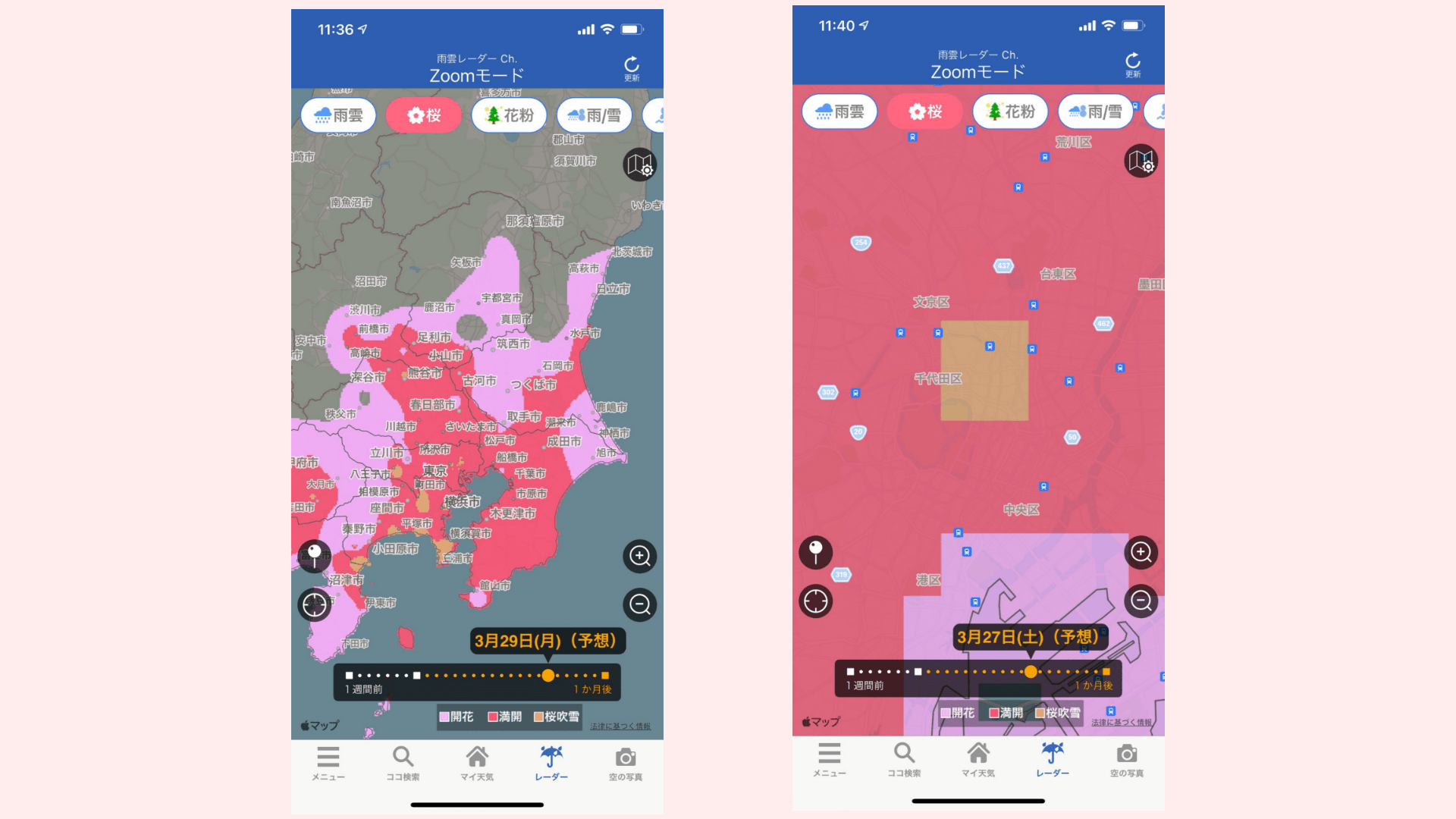
This raises a common question among our users: "When will the cherry tree in my neighborhood bloom?" To address this need, Weathernews delivers bloom forecasts using industry-leading 250-meter mesh resolution data.
Our proprietary "Sakura Radar" visualizes blooming stages—including first bloom, full bloom, and petal fall—across map regions in 250-meter increments. Users can track the progression of the cherry blossom front with daily updates for up to 14 days ahead, and three-day intervals extending to one month in advance.
The Sakura Radar is accessible through both the Weathernews mobile application and web platform.
Additionally, users can leverage our "Sakura AI Bloom Forecast" feature, which predicts bloom timing for individual cherry trees through simple bud photography. We designed these tools to enhance your cherry blossom season experience and anticipation.
The cherry blossom forecasts produced by Weathernews represent more than meteorological expertise alone. They're made possible through our nationwide community of supporters who diligently monitor their "My Sakura" trees and contribute daily observations.
This year's forecast predicts Tokyo's first bloom on March 19. From the moment buds open and the city transforms with delicate pink hues, through the gentle cascade of falling petals and emergence of fresh green foliage—we're honored to experience the remarkable journey of cherry blossom season alongside all of you once again. 🌸
Share
![[Developer Interview] Building the World’s Most Accurate Wave Forecasting Model](https://gvs.weathernews.jp/wni_blog_media/large_20260331_TOP_177db7c4c9.JPG)
April 1, 2026
[Developer Interview] Building the World’s Most Accurate Wave Forecasting Model

April 1, 2026
Enhancing Safety for Vessels and Coastal Operations with a Weather IoT Sensor You Can Deploy Anywhere: Enabling Hyper-Local AI Forecasting in Ports

March 27, 2026
Ogasawara Islands to Achieve Japan's Highest Weather Observation Density Through Digital Innovation