[Transcript] FY2026 Full-Year Financial Results Presentation
July 9, 2026
Script for the FY2026 Full-Year Financial Results Briefing
Download the Presentation Materials

Thank you all for taking the time to join us today.
Our agenda today is quite full. First, the FY2025 full-year results overview. Then, since this is the final year of our three-year mid-term plan, a summary of that plan. And finally, our FY2026 earnings forecast. I would like to proceed in that order.
First, the FY2025 full-year results overview.
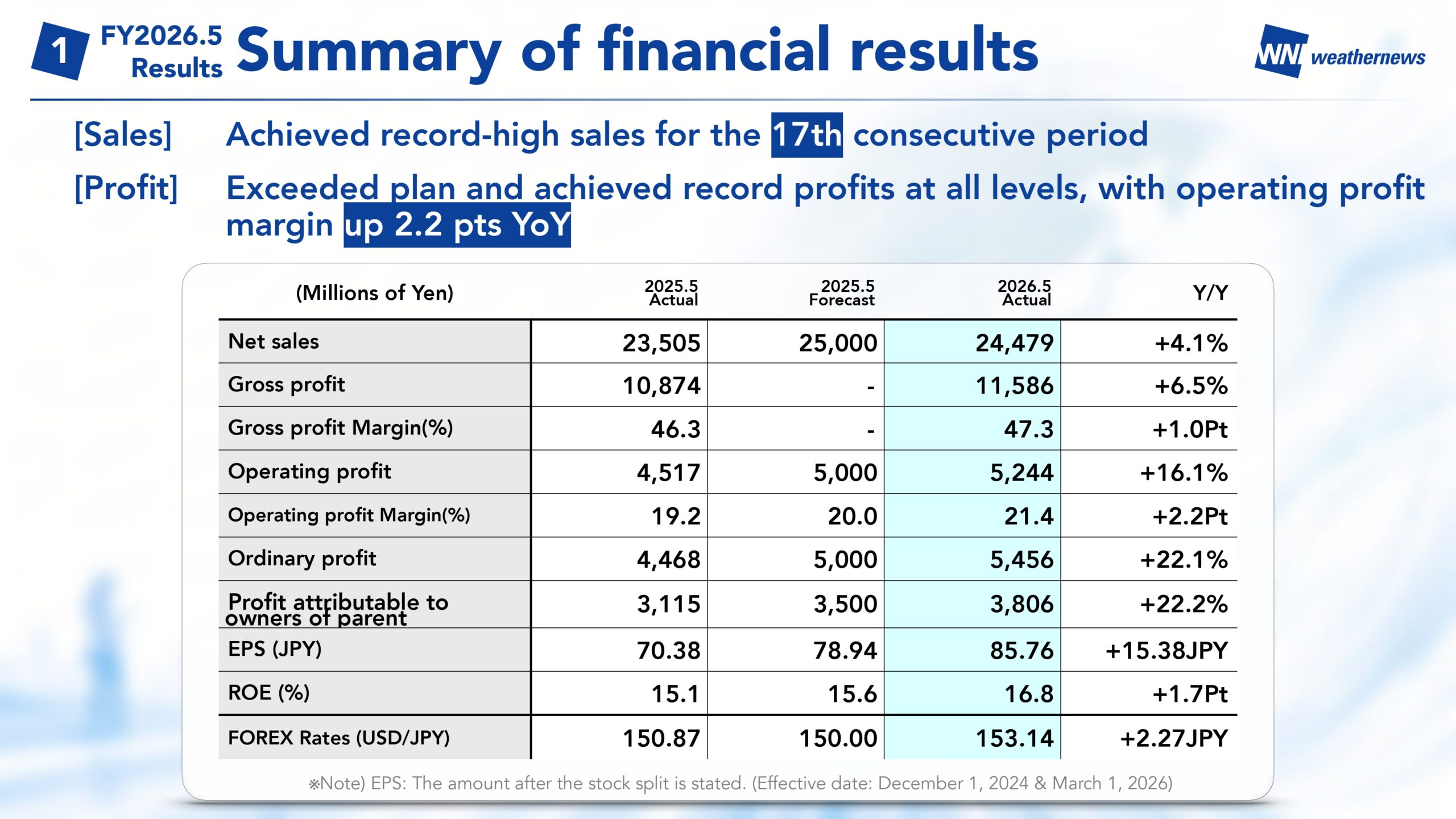
Starting with the summary, when all was said and done, we extended our streak to 17 consecutive years of sales growth. The operating profit margin also rose 2.2 percentage points YoY.
For the past few years, our motto has been to build a solid, profit-oriented structure, so we are encouraged to see the results coming through.
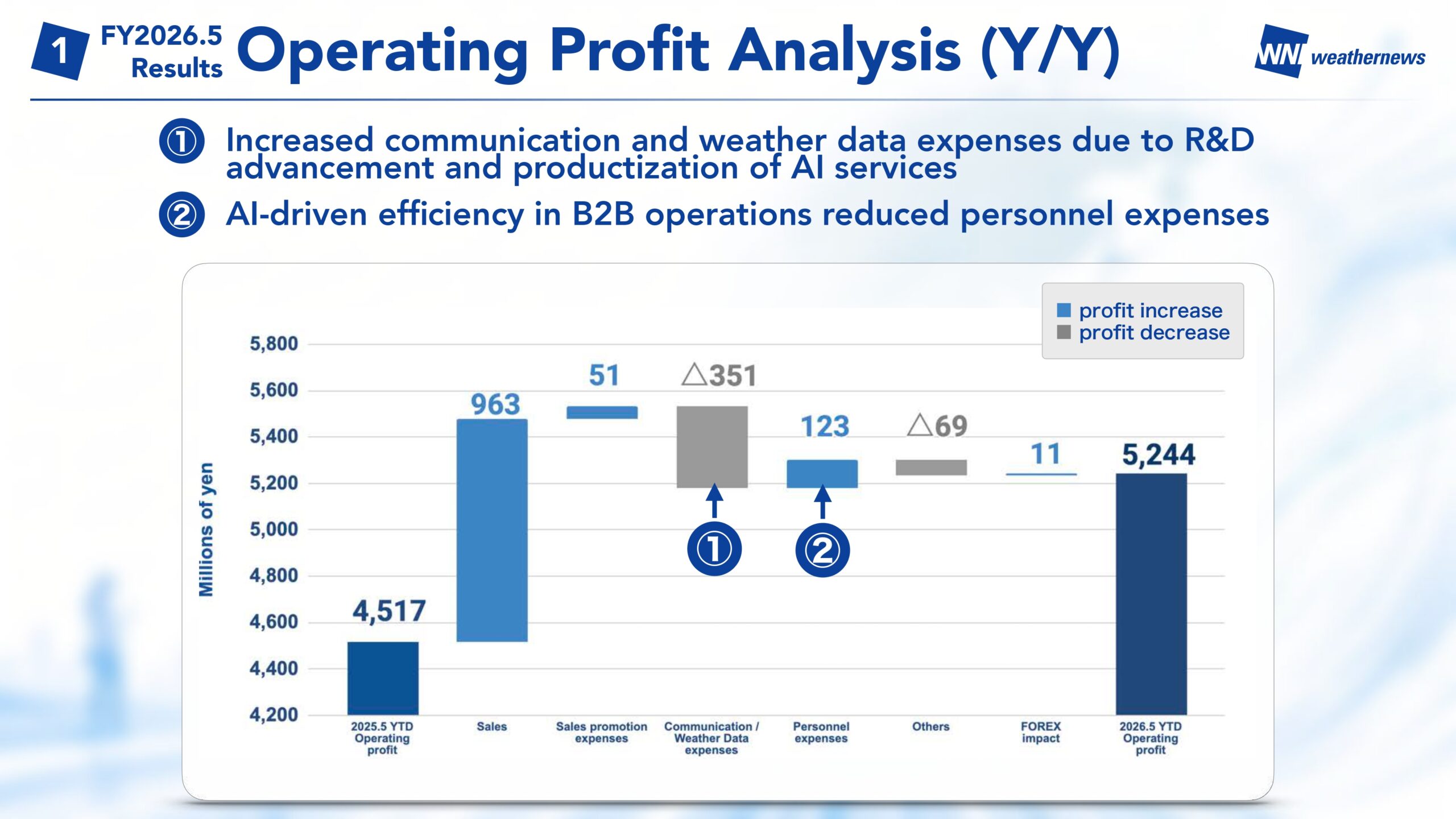
Next, the change in operating profit.
The structure is very simple. First, sales rose sharply, by JPY960 million. On top of that, because we are investing in AI, we spent more on data and communications, while AI-driven efficiency gains optimized our personnel expenses, and that pushed profit up. In the end, operating profit came to JPY5.24 billion.
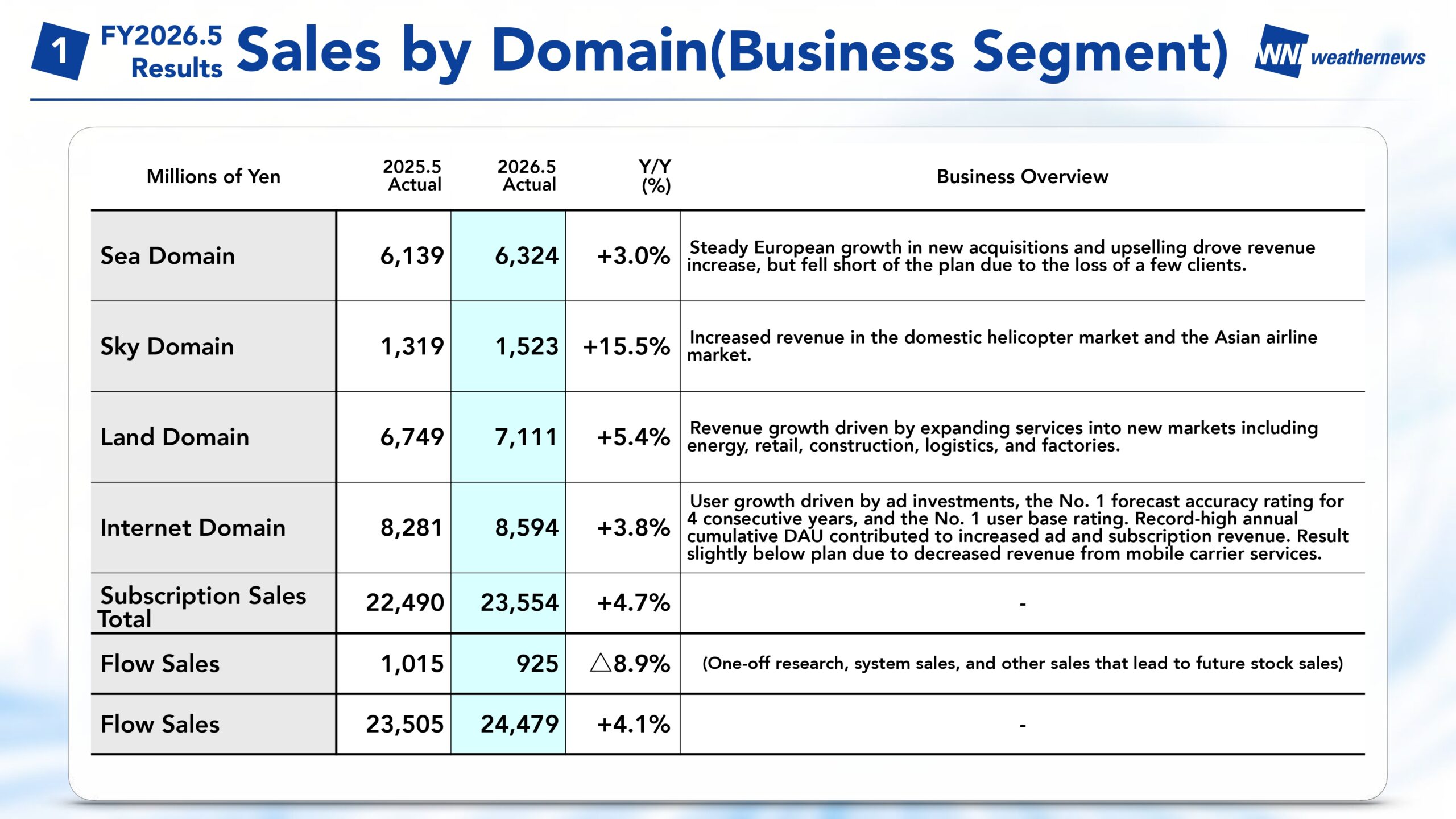
Next, sales by domain.
Solid sales growth in every domain is what drives Weathernews's growth.
I will go through each one later, but for sea, although we lost a few clients, sales grew, led mainly by Europe. Sky rose 15.5%, riding an updraft, so to speak. In the land domain as well, new services have become a solid sales driver.
In the internet domain, although we wound down some legacy services for a mobile carrier, DAU reached a record high over the year, and advertising and subscription sales grew.
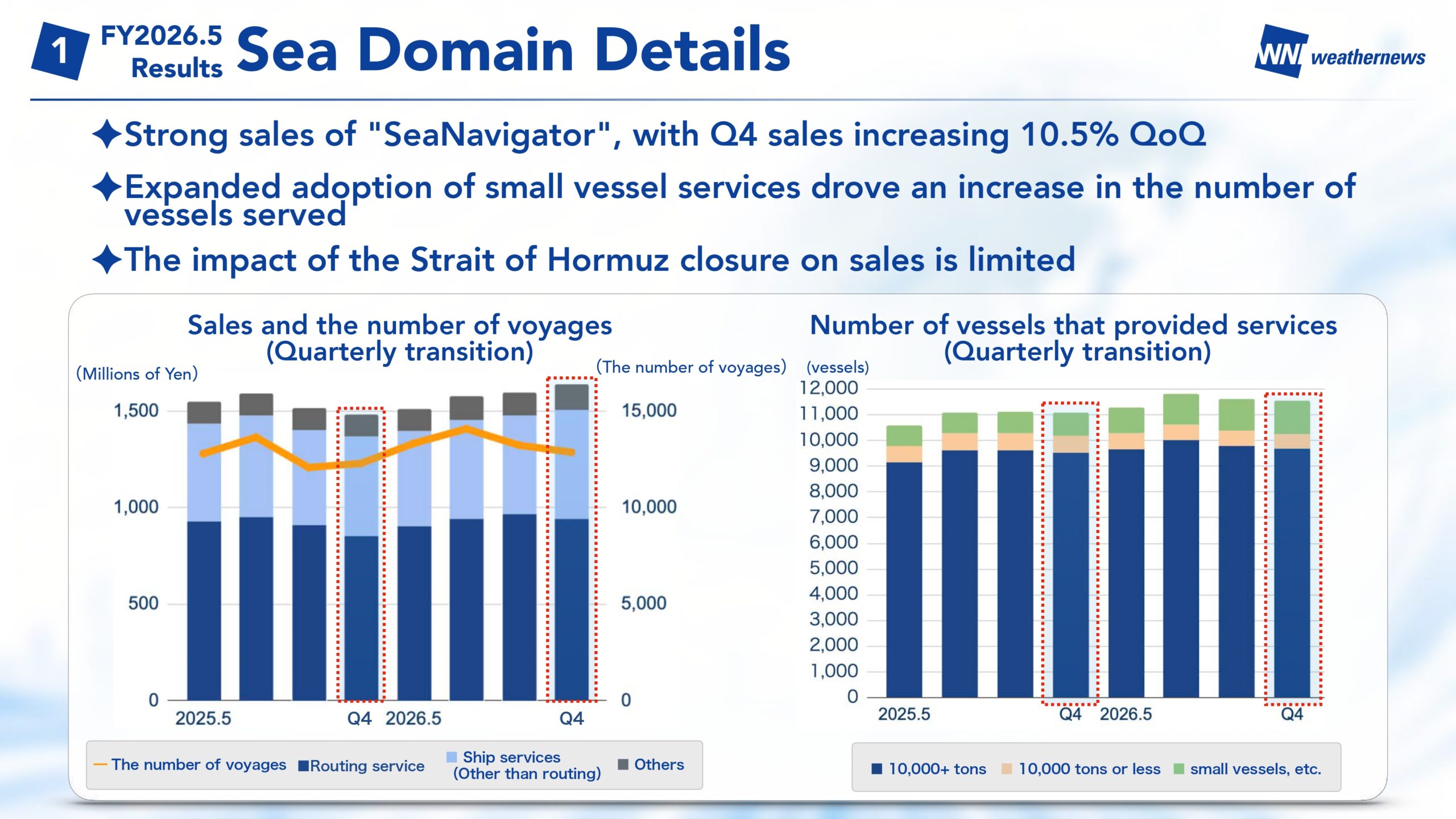
Next, let me go through one Domain at a time. Firstly, the sea domain.
"SeaNavigator" sales are strong. On a Q4 YoY basis, they grew double digits, so we are starting to see signs of a recovery.
In addition, the number of vessels using our small-vessel services is increasing, as shown by the increase in the green portion of this chart.
On the Strait of Hormuz, which some of you may be concerned about, the impact on sales has been a slight decline, but only a marginal one, almost negligible.
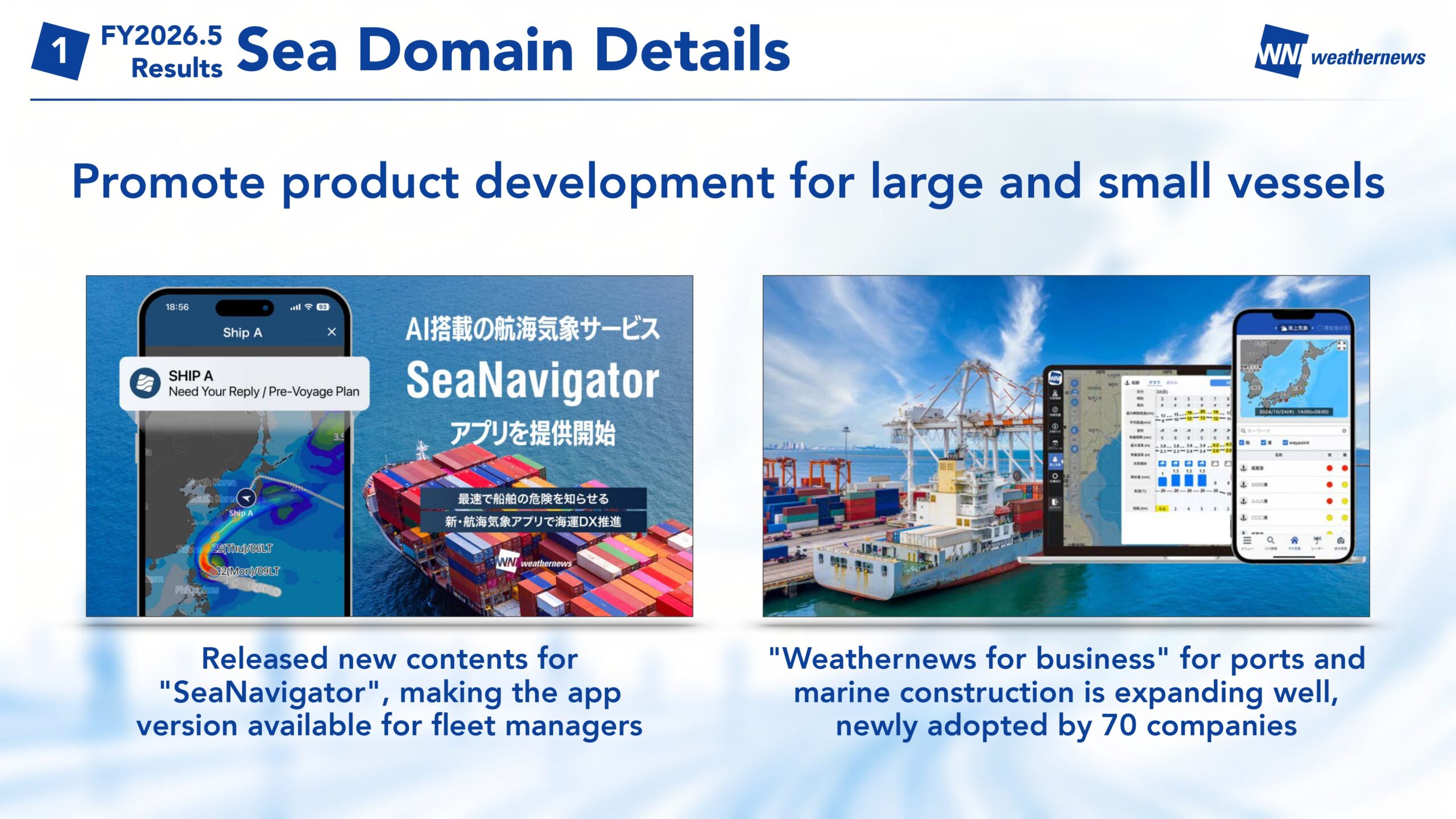
Recently, we have been continuing to roll out new products for both large and small vessels.
This is the "SeaNavigator app", shown on the left. A vessel's operation manager can check the status of their own ships from the app and receive alerts if anything happens.
Next, on the right side, is our “Weathernews for business” service for ports. A total of 70 companies have already adopted it, so we are seeing a good start.
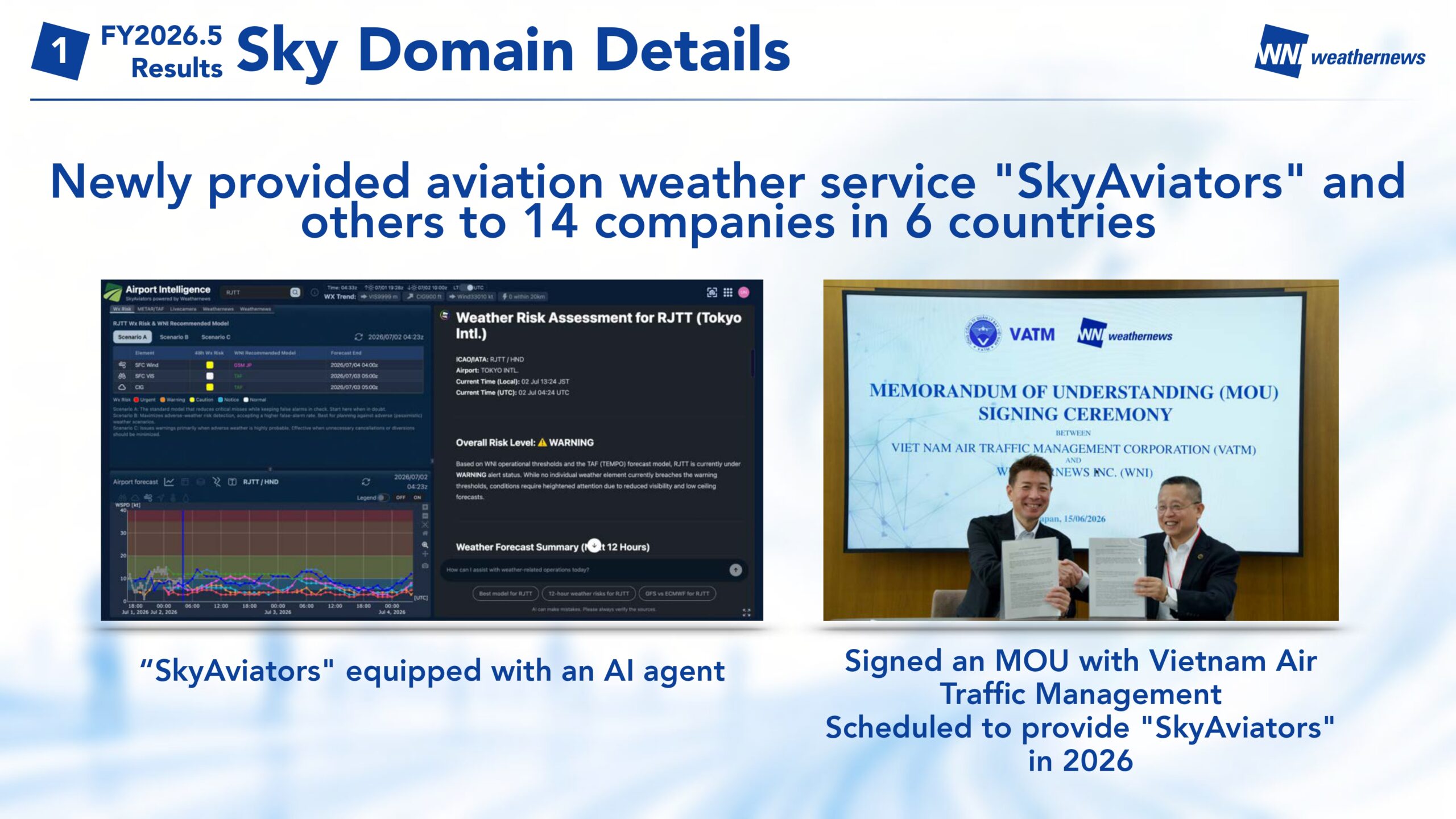
Turning to the sky domain.
Here, we have begun providing "SkyAviators" to 14 companies in six countries, and recently we have also added an AI agent feature in it.
Vietnam Airlines was already a customer, but we have now signed an MOU with Vietnam Air Traffic Management, and in the near future they will use "SkyAviators". That is a B2G arrangement, and this kind of business is moving forward as well.
Now, the land domain.
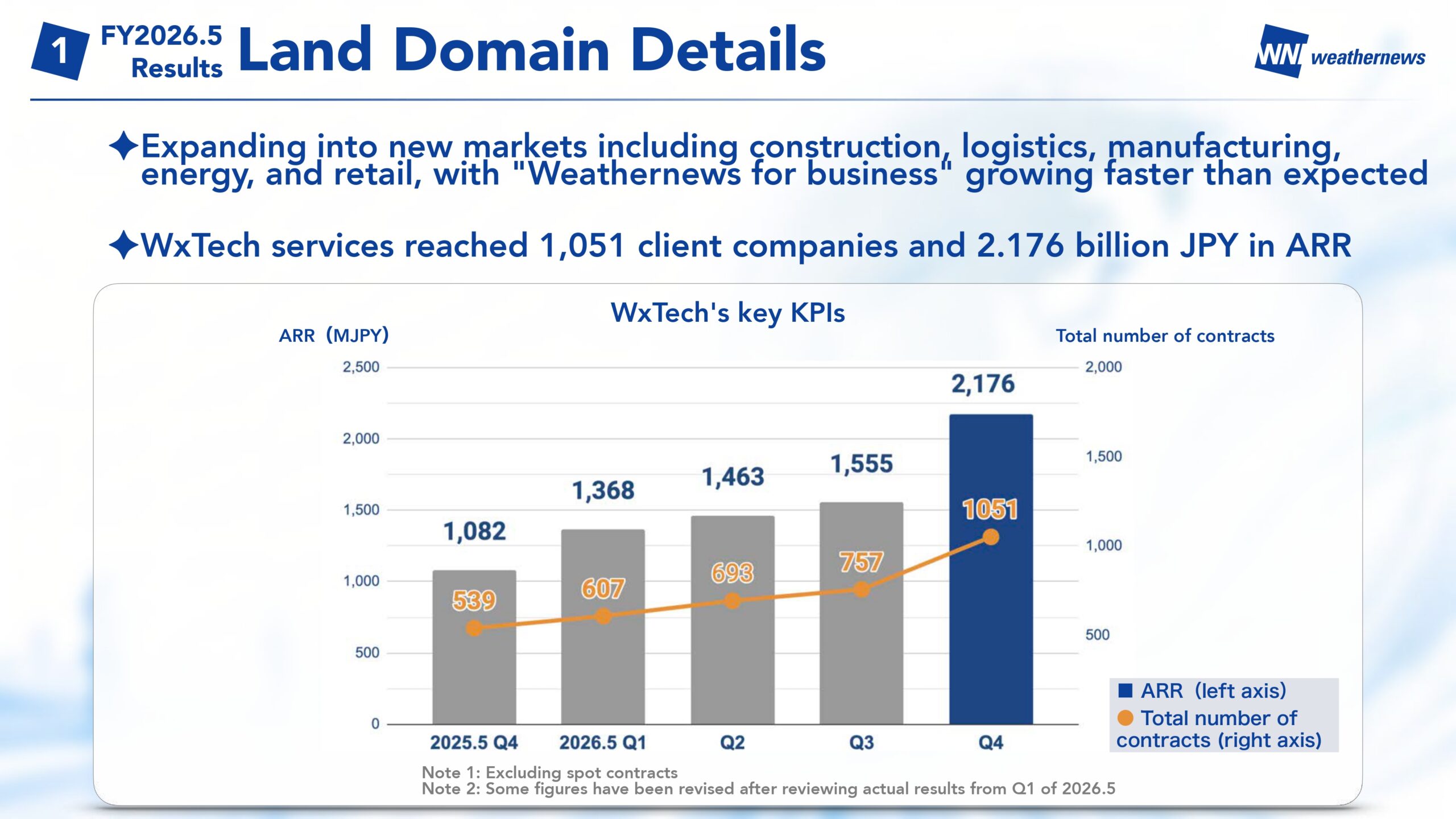
This is “Weathernews for business,” a service that lets corporate customers use our business services through both the familiar smartphone app and a PC. Adoption is growing faster than we expected.
ARR has now built up to more than JPY2.1 billion. New contracts increased in Q4 , lifting ARR sharply.
Indeed, the service is growing solidly ahead of our original target.
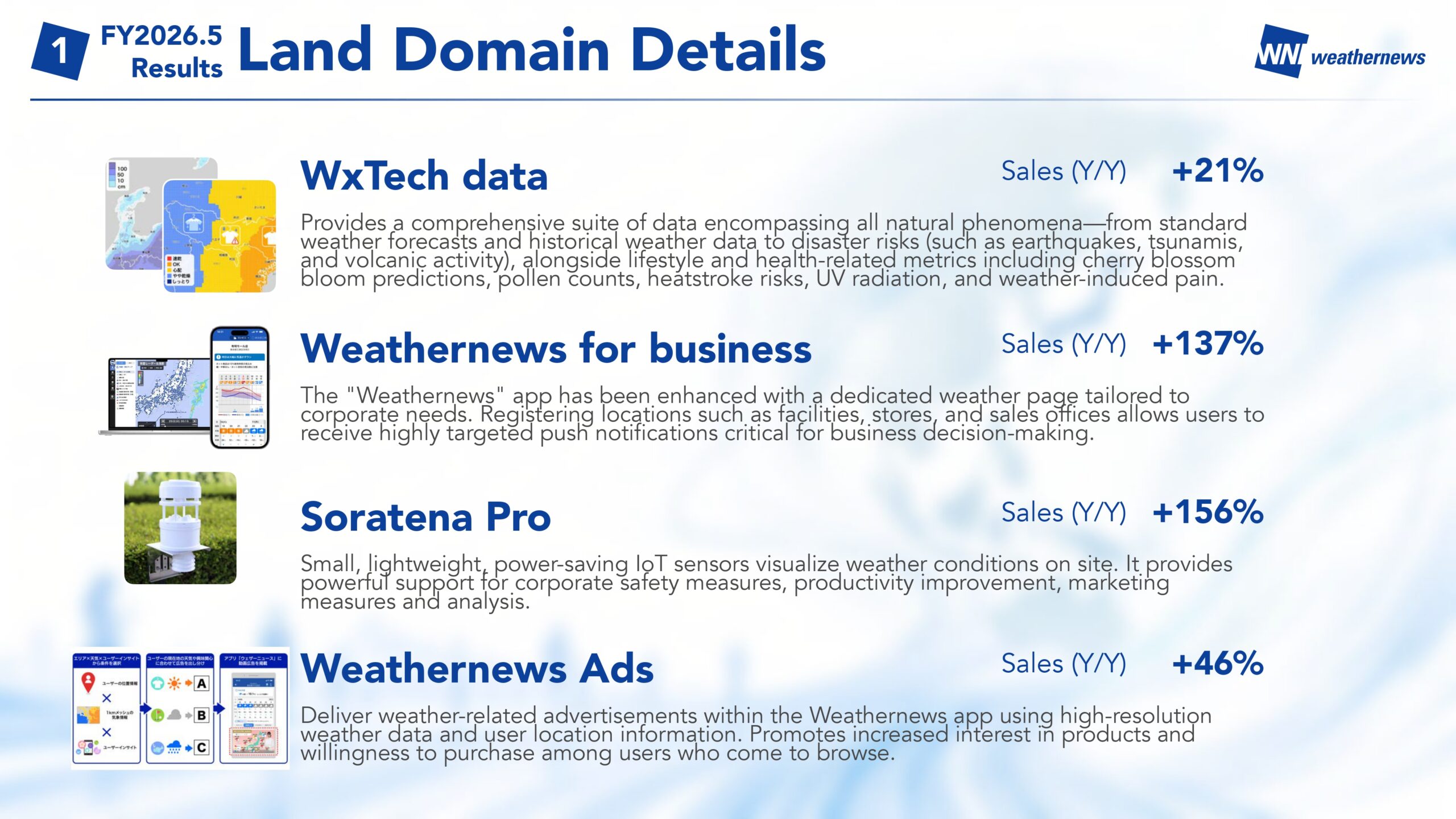
Breaking down the land domain's main services, we have data sales, “Weathernews for business”, "Soratena Pro" observation units, and the "Weathernews Ads" business, and every one of them grew solidly YoY.
"Weathernews for business" grew by 137%, so sales rose roughly 2.3 times. Demand for observation devices is also rising rapidly, as Soratena Pro addresses increasingly serious problems such as heatstroke.
Next, the internet domain.
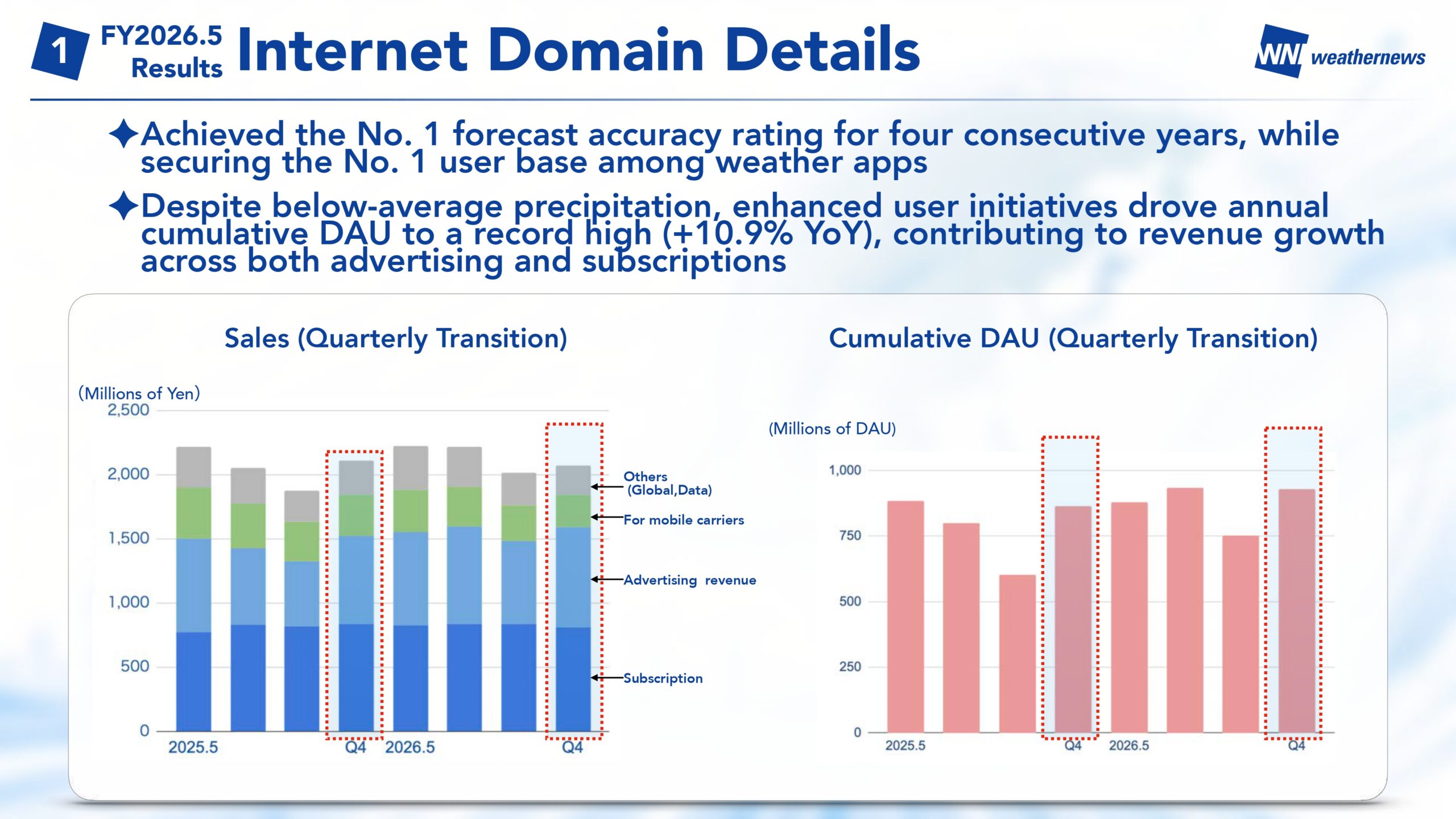
For the full year, we ranked number one in forecast accuracy, and at present we are number one in the number of users as well.
Looking back on this FY , we had so little rain it made us wonder where the rainy season went. But in the end, our day-to-day access, our DAU, was up 10% for the year, and that drove growth in both advertising and subscription sales.
In the internet domain, we are also steadily preparing for global expansion.
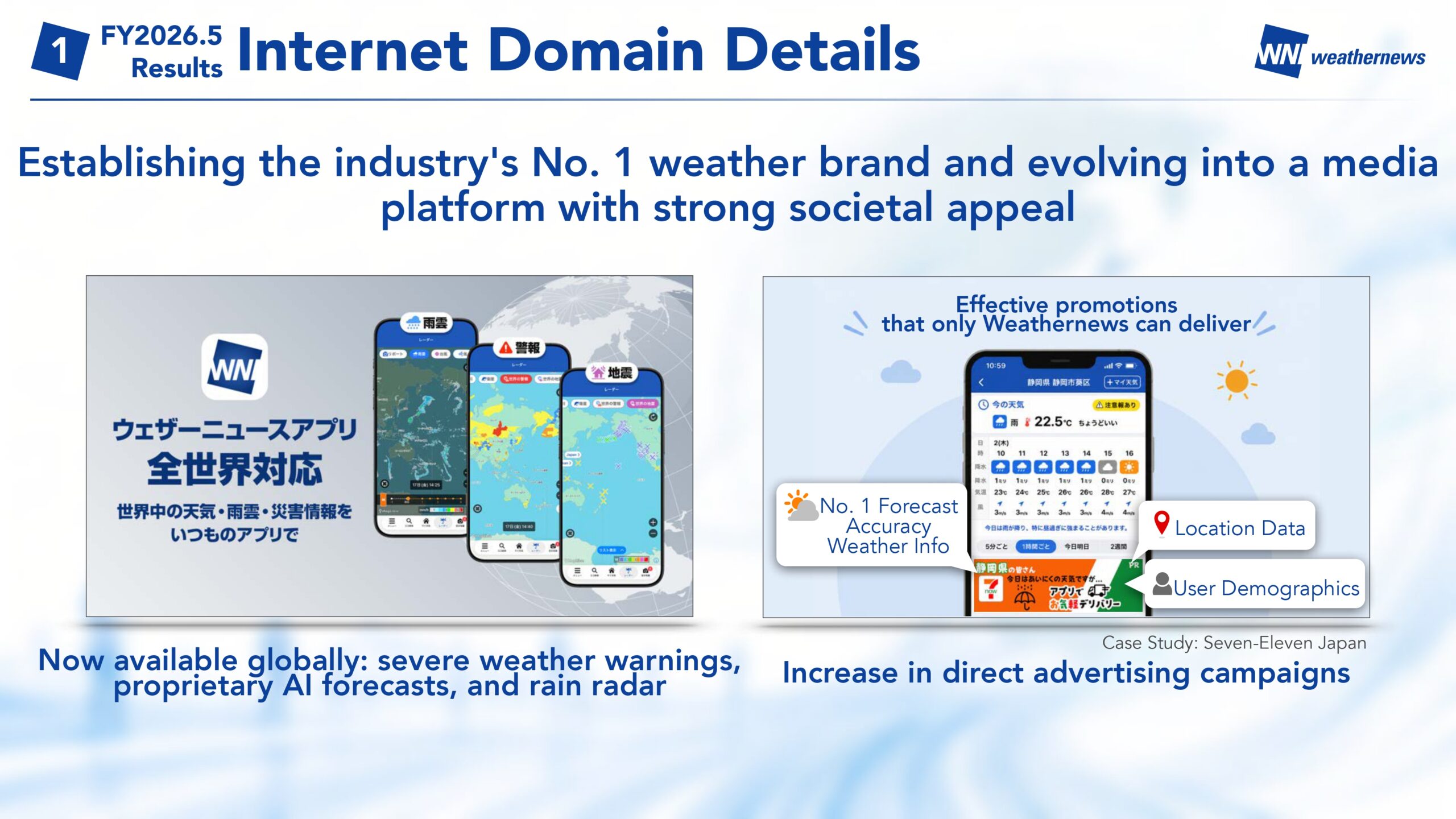
The other day, we issued a press release announcing that the Weathernews app now works worldwide. Take the app we all use in Japan anywhere in the world, and you can see high-resolution rain radar and receive alerts. You can even view weather advisories and warnings from meteorological agencies worldwide, as well as earthquakes around the globe. Gathering this data and running reliable operations was quite hard, but as our foothold for going global, we have begun by adding worldwide support to the app we provide in Japan.
Our media platform has also gained scale. As DAU rises, we can offer advertising opportunities to more customers, and our direct advertising deals are increasing steadily.
That covers the FY2025 full-year results overview.
From here, let me move on to a summary of the previous mid-term management plan.
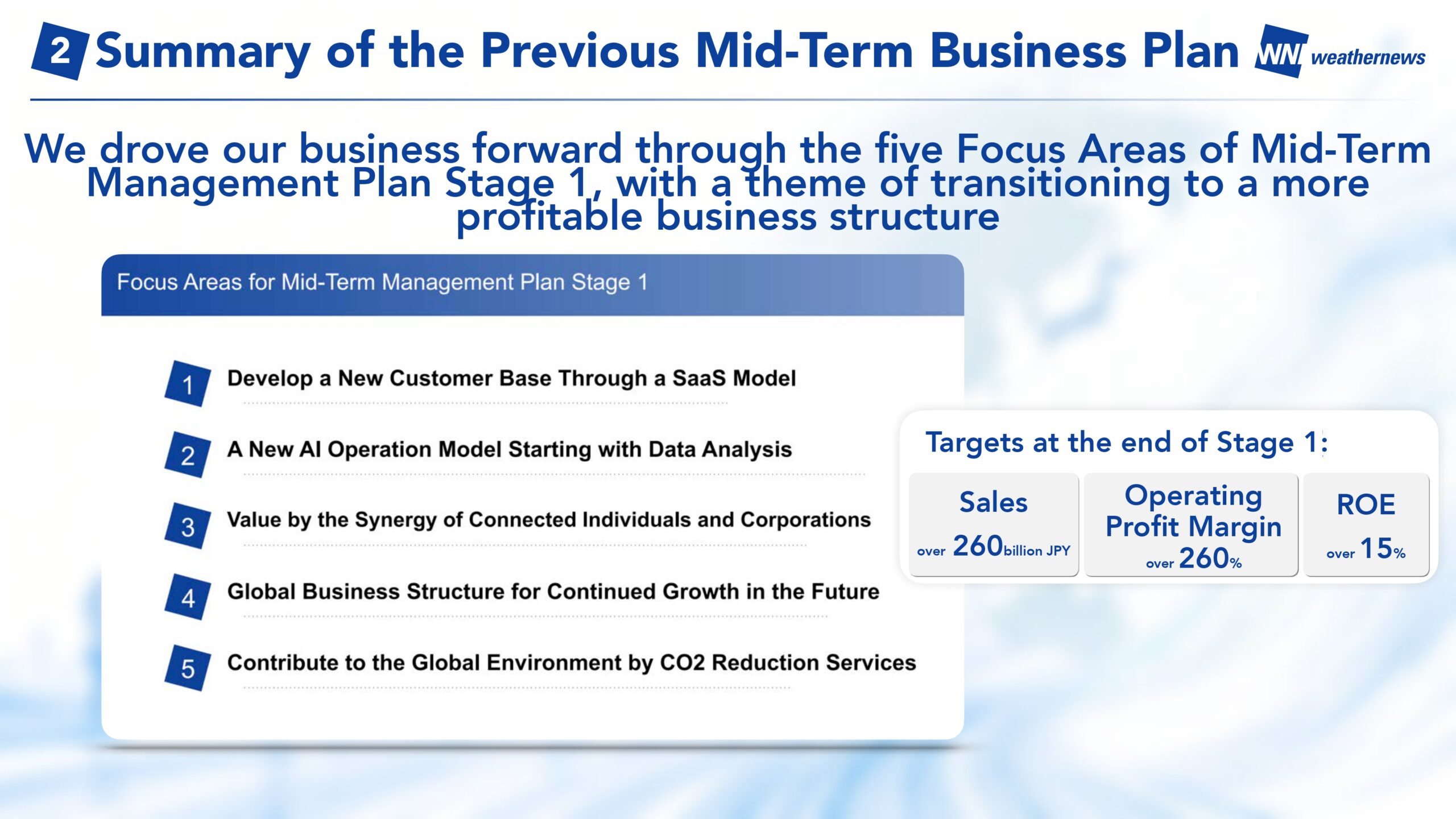
Three years ago, we laid out five focus areas, along with the numerical targets shown here. Let me look back on each one.
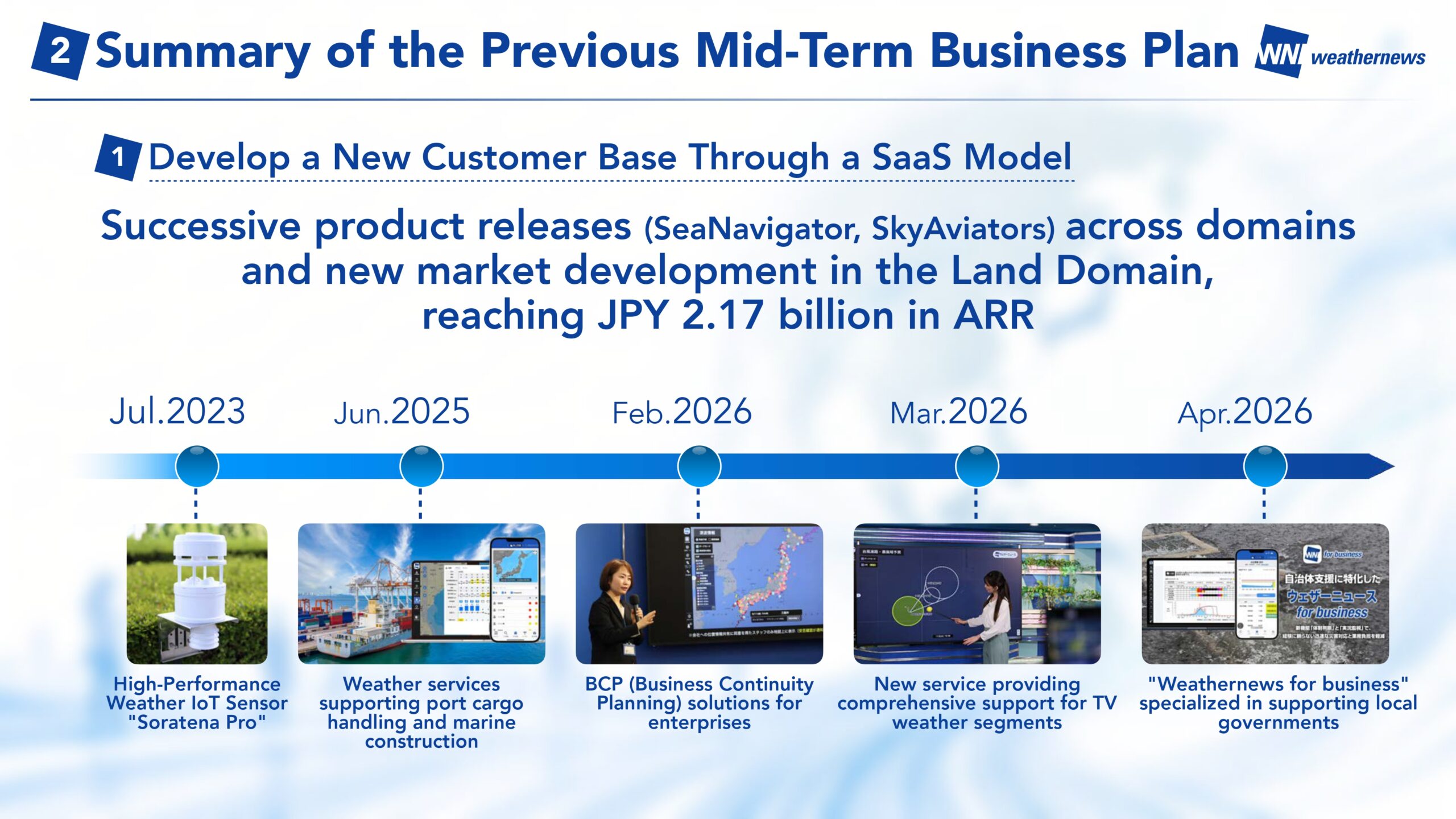
First, developing a new customer base through a SaaS model.
Given the recent SaaS trend, this may be the last time I use the word "SaaS" here. But three years ago, we used that as our keyword for rolling out more and more of these products.
As a result, in each domain we have released various software-type solutions: "SeaNavigator" and "SkyAviators"; while in the land domain, our popular "Weathernews for business".
More specifically, we use agile development and update these services roughly once every two weeks. By doing so, we have kept refining them so customers can continue using services that match their current needs.
At this point, I believe we have already reached product-market fit, so the next phase will be about driving penetration and expansion.
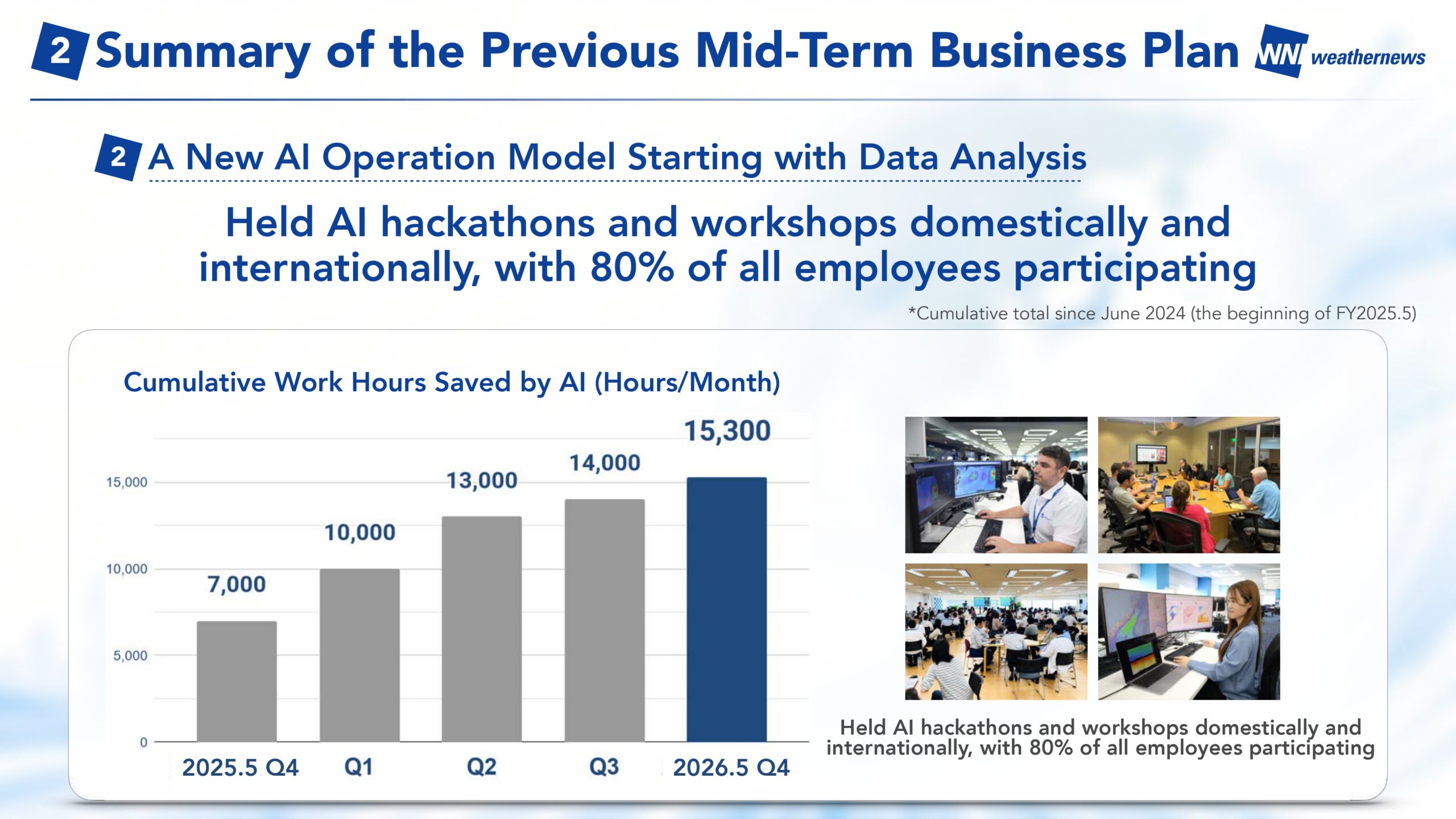
Next, the second focus area: establishing a new AI-based operating model that starts with data analysis.
As a result, over these two years we have achieved a reduction of 15,300 work hours per month. For us, that is a very significant achievement, and I believe we have created a good cycle in which we use that freed-up time for higher value creation.
In short, all of our employees make full use of AI. We hold AI workshops all over the company, and recently we have what we call AI DLC, or AI development life cycle, in which small teams use AI to build products on the spot across sales, operations, and development. We are doing this everywhere inside the company. All of that has added up and ultimately translated into a reduction in internal workload.
This pace has not slowed at all, so we keep handing existing tasks over to AI and shifting people toward what only people should do, such as understanding where customers are struggling.
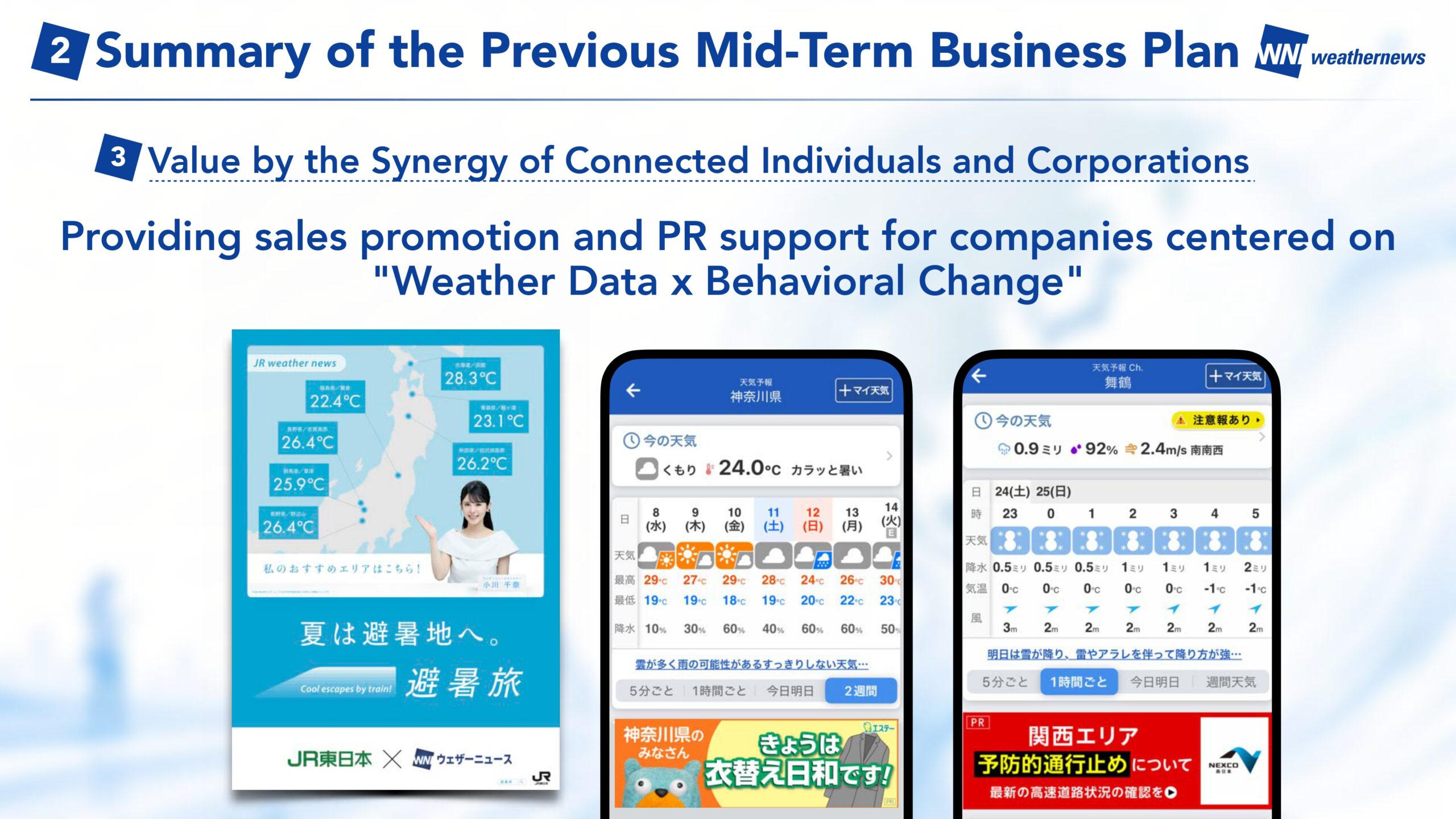
Next, the third focus area: creating value through synergies between our individual and corporate businesses.
Weathernews has both an individual business and a corporate business, and I take pride in the fact that this gives us a truly one-of-a-kind position, even among weather companies.
The example shown here is a case where we supported a major corporate customer's PR and sales promotion, which led to Ads sales. As another example of this, when we developed the SeaNavigator app, our B2C developers closely shared their expertise with the B2B team. I believe we are seeing this kind of internal synergy emerging across many different areas.
This may also be the last time I use the word synergy, because within our company it is already a given that our individual and corporate businesses reinforce each other. By making good use of that unique position, we want to keep launching new services from here.
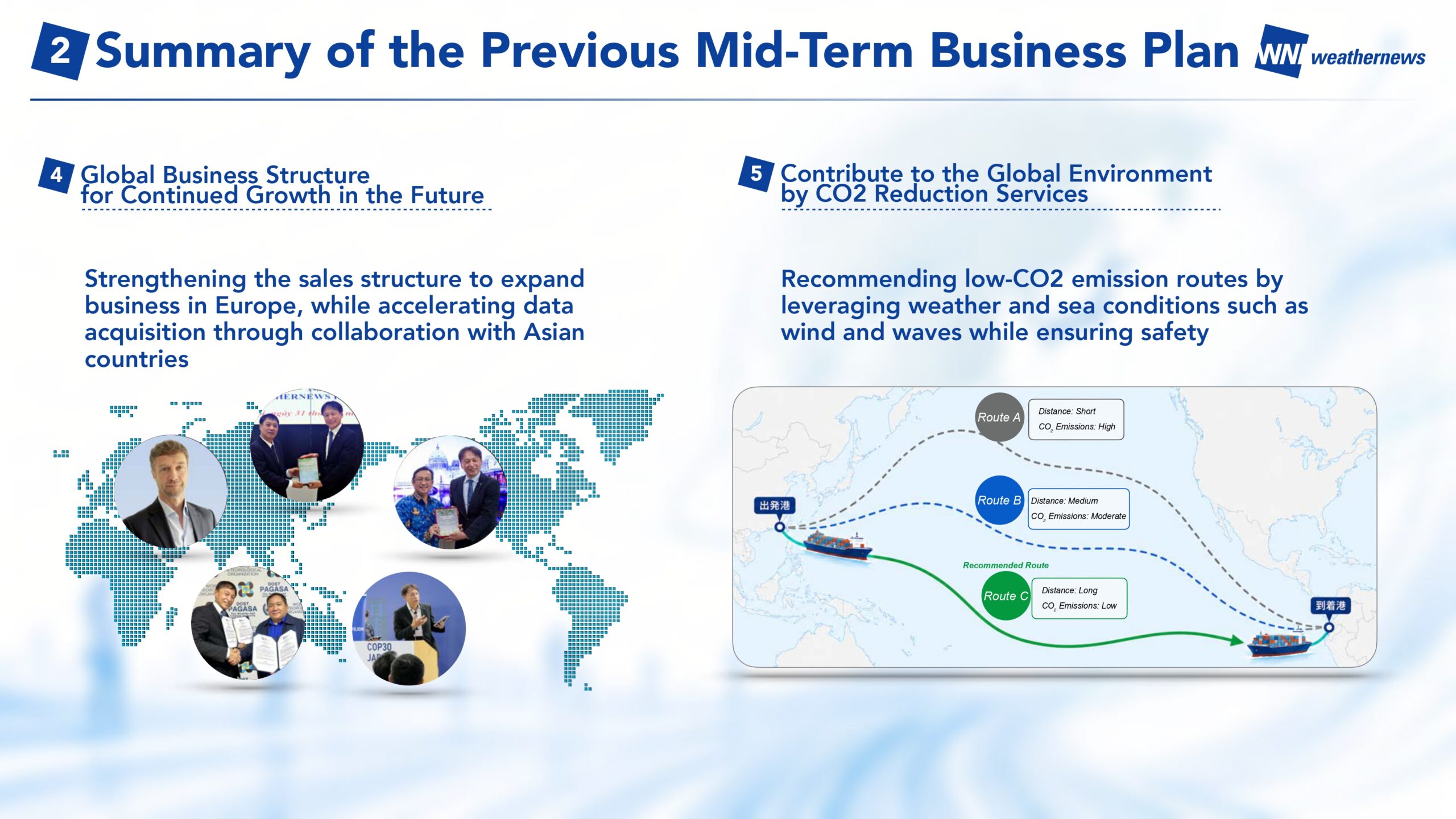
Now, the fourth and fifth focus areas.
First, the fourth: building a global structure for continued growth in the years ahead. Since we aim to grow globally going forward, we decided to build the structure first, hiring a CEO for Europe and steadily laying the foundation for global growth by signing MOUs with various meteorological agencies.
And the fifth: contributing to the global environment through CO2 reduction services. This is a service we call “Fuel Routing” for ships, which is about how to reach the destination on time while burning as little fuel as possible. Through services like that, we are contributing to our customers' decarbonization.
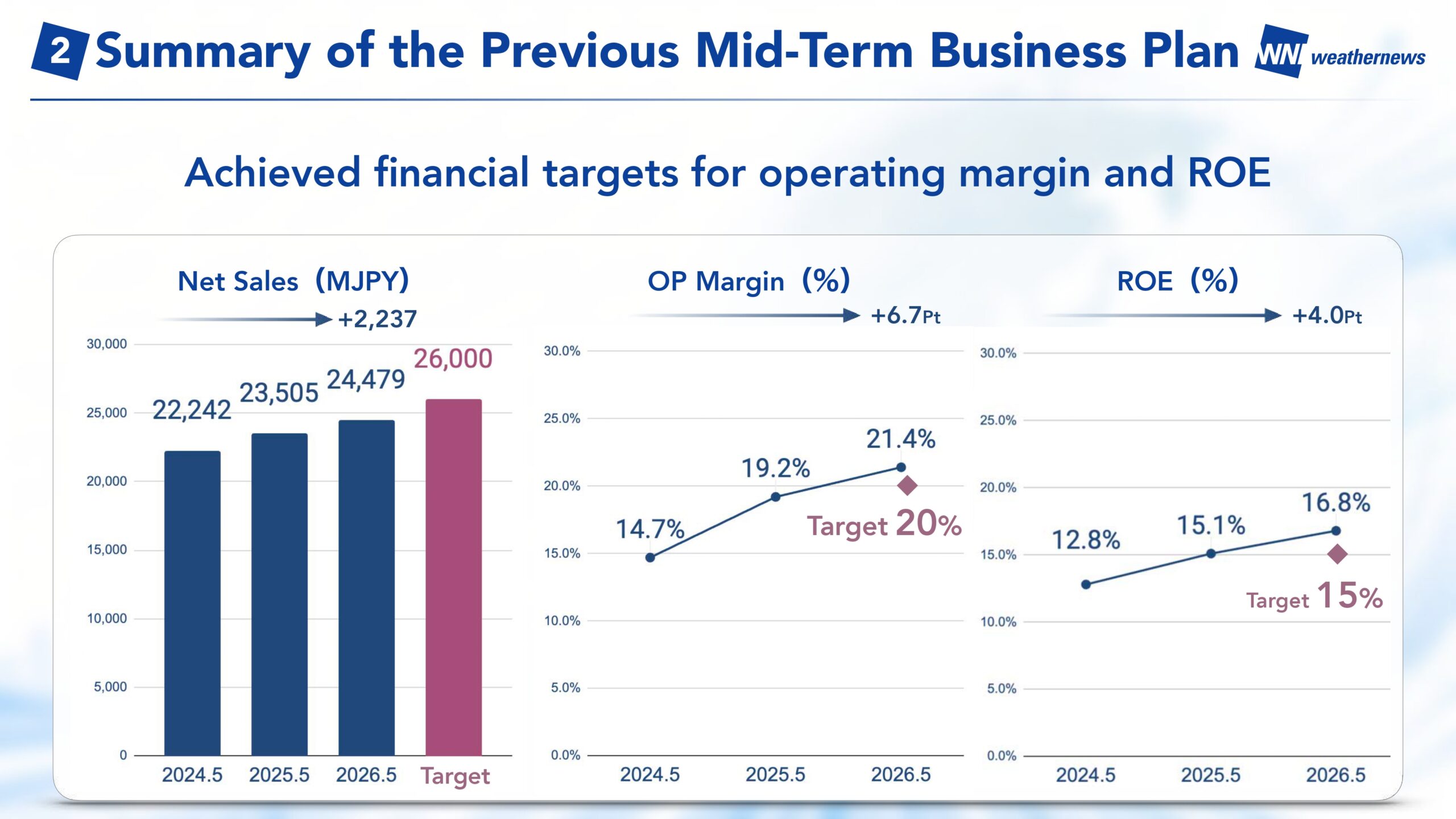
Finally, the results against our financial targets.
Sales, operating profit margin, and ROE: over these two years, sales rose by about JPY2.2 billion, the operating profit margin by 6.7 percentage points, and ROE by 4 percentage points.
On the targets, the sales target of JPY26 billion was one we came in slightly short of, but we comfortably exceeded the 20% operating profit margin and the 15% ROE.
In any case, for this previous mid-term plan, our approach was to first become profit-oriented and then grow from there, so we ran the business with a strong focus on things like the operating profit margin.
We feel very encouraged by the results, and I believe we are getting ready to move onto a solid growth track from here. I hope you will look forward to what comes next.
Next, the third topic: our FY2026 full-year earnings forecast.
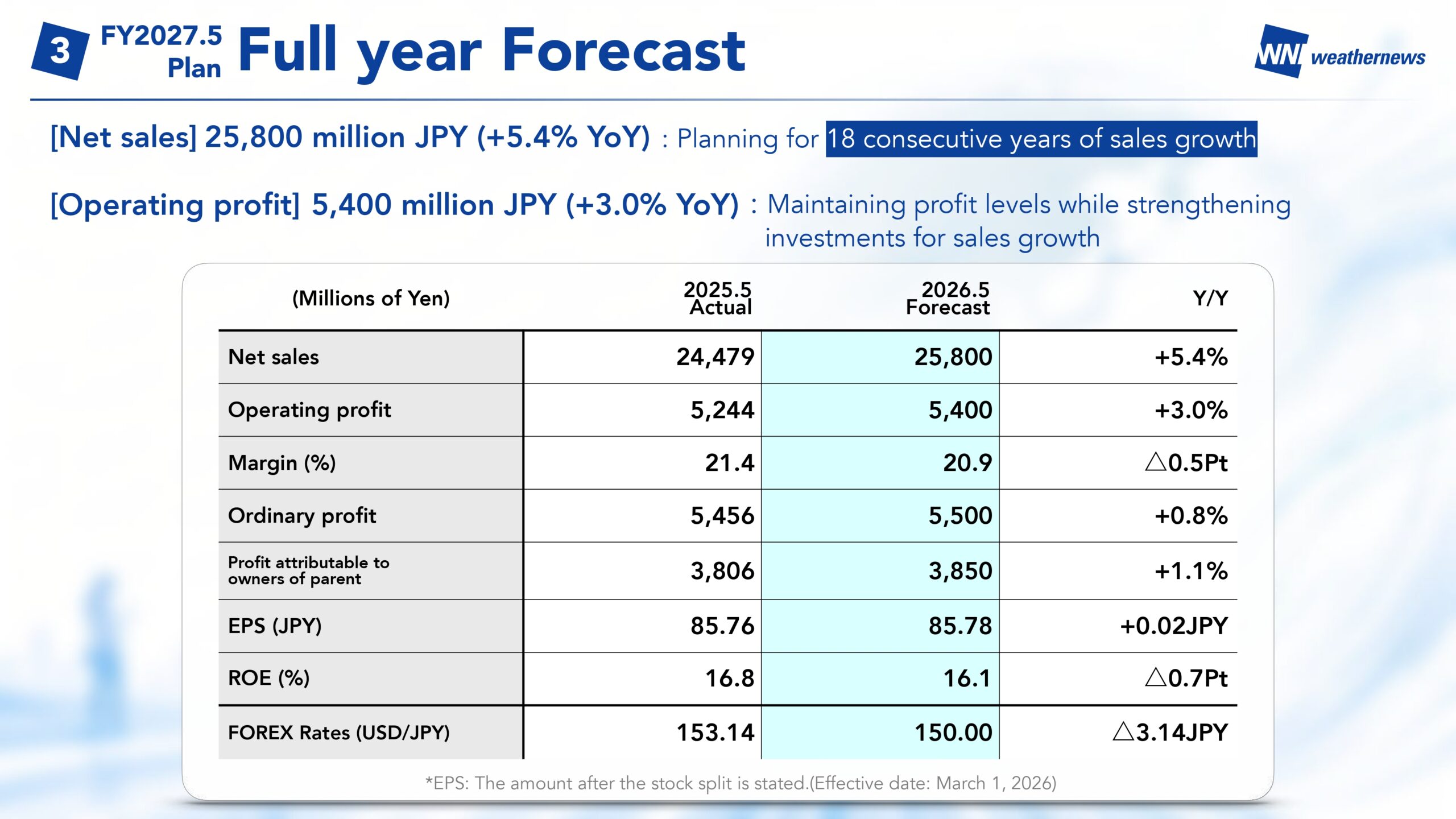
This too marks our 18th consecutive year of sales growth, up 5.4%. On operating profit, we will be investing in earnest from here, so for now our plan is to hold profit at the same level while we invest.
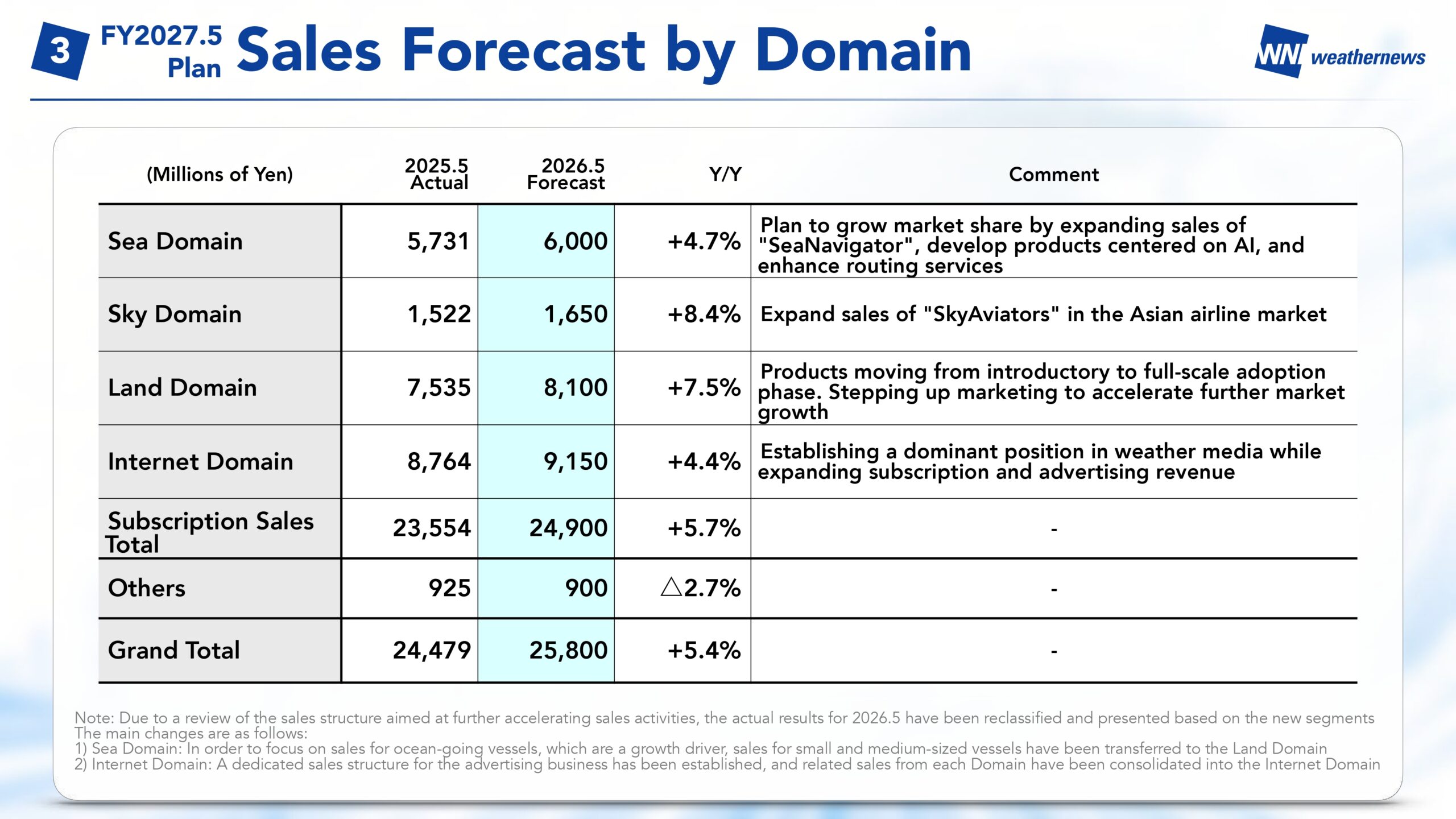
For the sales forecast, the framework of solid growth in all domains—sea, sky, land, and internet—is unchanged.
In the sea domain, the key is to keep selling SeaNavigator.
In the sky domain, it is to expand SkyAviators sales to airlines.
In the land domain, products like Weathernews for business are no longer in an introductory phase but in a phase of full-scale rollout, so we want to put our energy there, including promotion.
In the internet domain as well, our plan is to firmly hold our number one position while expanding subscription and advertising sales.
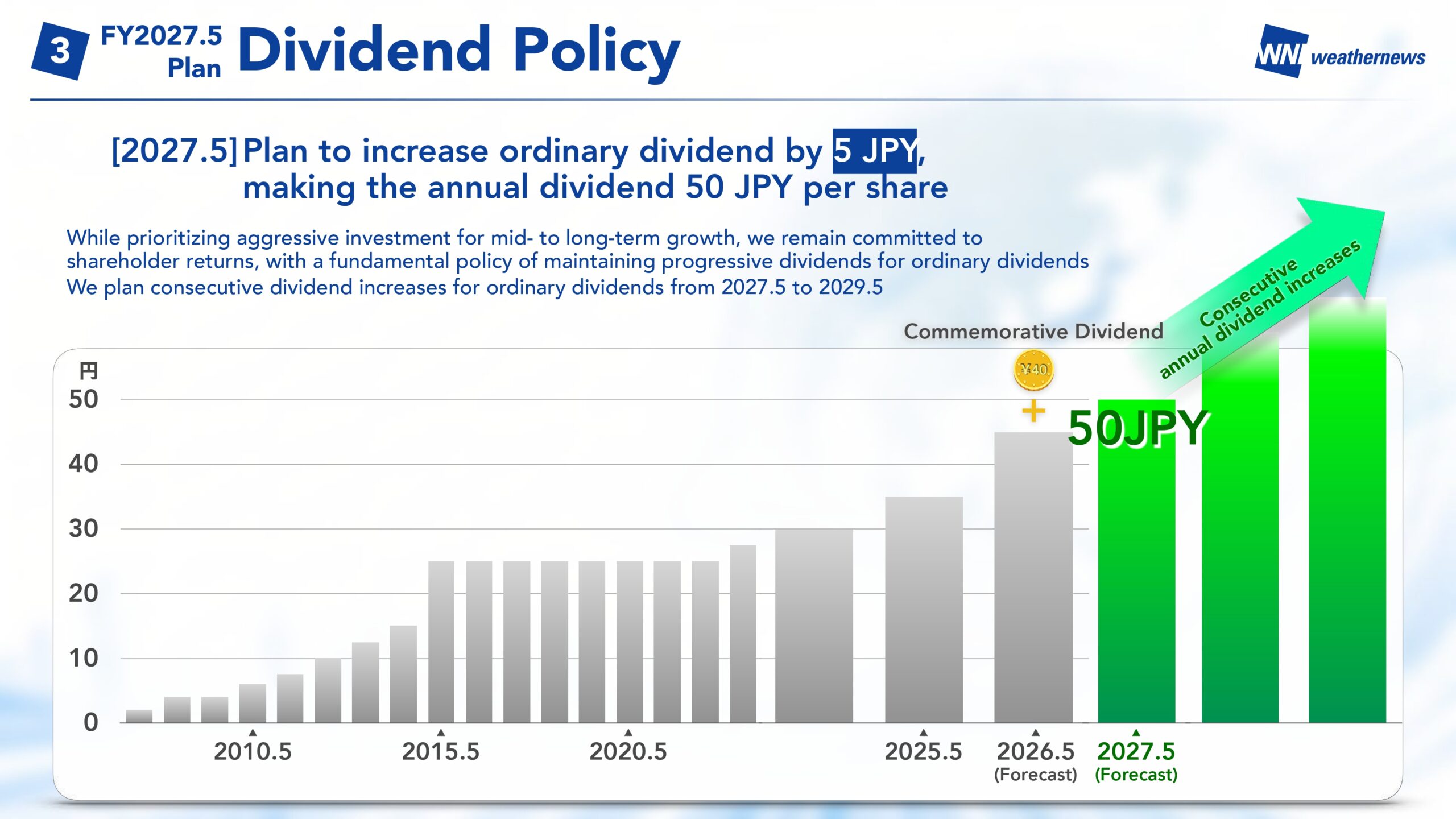
Finally, our dividend policy.
For the ordinary dividend, we plan to raise it by JPY5 to an annual dividend of JPY50 per share. Beyond that, our plan is to raise the dividend every year.
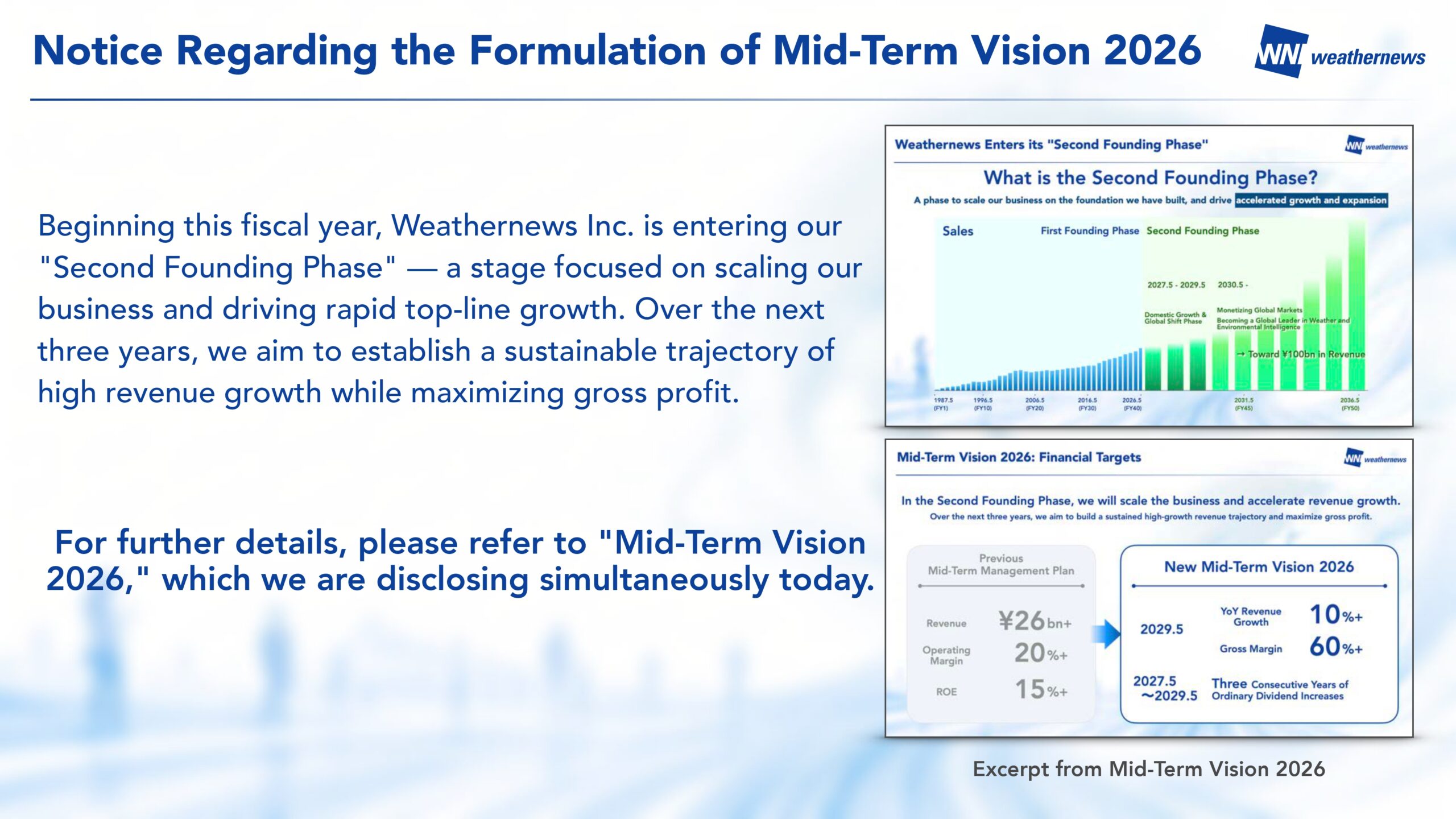
In fact, today we released something we call “Mid-Term Vision 2026.”
There are a couple of slides on it here. We have defined this, from 2027.5 period, as our Second Founding Phase. Up to now was our First Founding Phase, in which we built out our various foundations, and from here the plan is to grow aggressively on top of them. This new Mid-Term Vision lays out a path toward JPY100 billion in sales, so I would encourage you to take a look at it.
That concludes my remarks.

[Q1]: Sea is expected to grow because SeaNavigator expands. Regionally, is there any particular pattern, such as Europe, where you reorganized, growing further?
Ishibashi [A1]: In Europe, there are still many places where competitors are active, so I think it will keep growing. Meanwhile, in Asia too, we have recently seen more cases of customers upgrading from services we already provided, such as adding IDs, so I think both Asia and Europe will grow.
In the US, some parts have not yet ramped up, and there are not that many ships, so I think the focus will still be Europe and Asia.
[Q2]: Also, on the new software, SeaNavigator for Master, which was released at the end of last year. How are its sales going?
Ishibashi [A2]: SeaNavigator for Master is a service that captains can view directly on board. The number of vessels adopting it is growing steadily. With for Master installed, the operators on shore use SeaNavigator, and the two link up to share information and finalize routes. We provide that kind of workflow, so we are now entering a cycle where, as SeaNavigator is adopted, for Master grows alongside it.
[Q3] For land this fiscal year, I believe you expect a high growth rate of 7.5%. There are various products, but what in particular do you see driving that?
Ishibashi [A3]: This is really centered on our products, mainly Weathernews for business. Some of the services we have provided so far are steadily migrating over to it. Actually, until now these were used by maybe 5 or 10 IDs, by safety-management departments and the like. With Weathernews for business, the number of IDs expands rapidly to include field staff and so on. That, in turn, is starting to create upsell to existing customers, so I think Weathernews for business will make a large contribution to land sales. There is something I forgot to mention earlier. In 2027.5, there is a reclassification of sales. That is why, on the earlier slide, sea was down a bit and land was up, with the details noted in the fine print at the bottom. Let me explain it briefly. Within sea, the port-related Weathernews for business, the part close to harbors, will move to the land domain. There are various reasons, but land's sales organization is nationwide, so we use that organization to reach ports and close those deals. It is a Weathernews for business product to begin with, and it is easier to sell and easier to cover that way. So the port-related Weathernews for business moves from sea to land. That is the first change. The second is that, actually, the land domain had also carried a certain amount of Weathernews Ads, our advertising business. When a land customer wanted to advertise, we had been tying those sales to the land domain. Going forward, we have now put in place a structure to run the advertising business in earnest, including a dedicated executive officer for it, so corporate advertising like that will be managed on the internet side. That is the sales reclassification underway, so please keep that in mind when you look at the numbers.
[Q4]:For Internet domain forecast, you are projecting 4% sales growth, while I assume the mobile-carrier portion will continue to decline. Are you fairly confident in that 4% growth figure?
Ishibashi [A4]: The start has been a very good one. We are off to our best start yet. In that sense, the number is not a stretch at all. If anything, I feel the internet domain should grow even more, so this is a very comfortable number for us, and it is off to a very good start.
[Q5]: I would like to ask about the mid-term plan. The First Founding Phase ended last fiscal year, and sales were JPY24.4 billion against the JPY26 billion plan, so it fell short. Sorry to ask, but what was the single biggest factor there?
Ishibashi [A5]: When we first drew up the plan, it was really sea. And I had also wanted internet to grow a bit more. Both are large in scale, so looking back, I think we wanted to grow them more. That was our situation three years ago. How much we can revive that in this new Mid-Term Vision is the question, I think.
[Q6]: You have released materials on overseas expansion and your longer-term goal of reaching JPY100 billion in sales. What, specifically, will drive the path to JPY100 billion? Will overseas growth be the main driver, for example?
Ishibashi [A6]: JPY100 billion, we will get there. When you look at our current sales scale, I am sure it seems quite hard to reach JPY100 billion. But we have solid numbers behind it.
For example, if you look closely at the materials for this mid-term plan, you can probably sense it. We are considering a range of things: various moves toward AI, our own business model, and, on the investment side, M&A as well. If we think about how to reach JPY100 billion organically, one path would be for all domains to reach roughly 10% YoY growth in about three years, then step that up to 12% and 14% in the following years. I do not know whether to call that a jet stream or an updraft, but once this ARR-type business gets properly on track, I believe we can steadily build sales growth, raising the YoY growth rate little by little. If all the domains get there, then in the end, in 10 years, in the 50th fiscal year, we reach right around JPY100 billion. So the first three years are very important: how far we can raise our presence globally, and whether every domain can get onto a track where 10% growth is a given, and then plus 2% and plus 3% on top of that. That includes various initiatives, such as making all of our forecasts AI-native. If we do those things well, I believe we can become the one-of-a-kind player that dominates this weather industry.
[Q7]: On overseas sales. In the sea domain you have sales in places like Europe and Asia, and sky also has sales in Asia and so on. Beyond those, for expanding overseas sales, you said you have finished preparing the Weathernews app for worldwide support. When will overseas sales from that start to come in?
Ishibashi [A7]: For this, I think it is upfront investment first. First, we get many people around the world really using our app. Japan is an unusually favorable environment with quite a long history, so I do not know whether it will look the same as Japan, but even overseas, I think we can realistically become something like number two or number three in a given country. If we reach that level in every country, then worldwide we would certainly become number one. There is truly no weather app anywhere as full-featured as the app we have in Japan, so I think how we use that know-how to build a global brand is a really exciting challenge for the next three years or so. Our business model does not end with the app alone. Closely linked to the app, we can also do B2B business, and government business connects to it as well. That is our unique position. We call it a "Loop", and if our business becomes that kind of Loop, then the app is not simply a B2C investment; we can position the app, as a form of media, as an investment in the entire company. I am very excited about that, so I hope you will look forward to it.