
December 18, 2025
A Complete Guide to Weathernews 360 Insight: The Tool That Forecasts Your Business



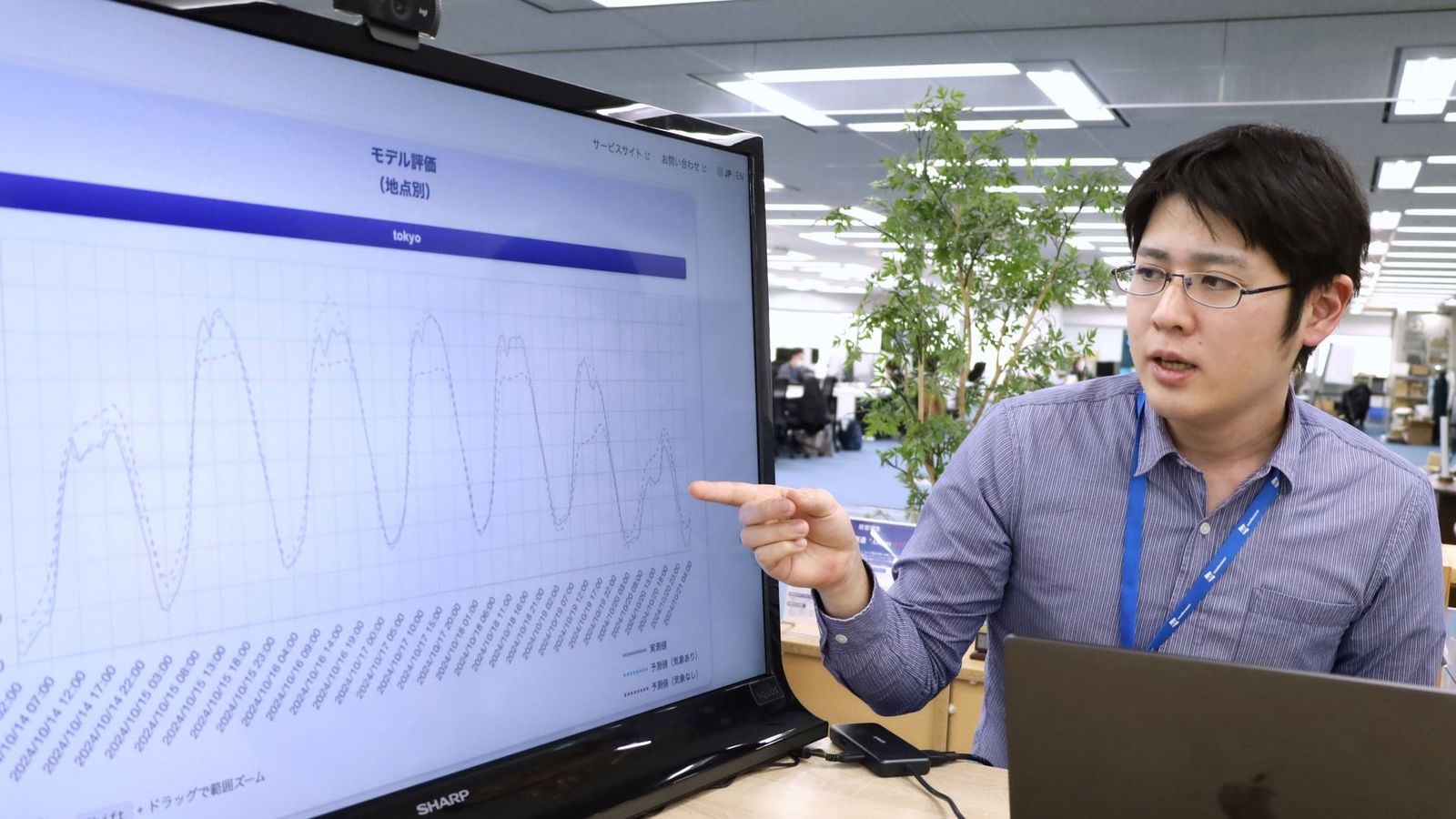
How much does weather really impact your business? More than you might think. From retail sales and restaurant foot traffic to manufacturing energy consumption and amusement park attendance, countless aspects of demand rise and fall with changes in temperature, precipitation, and humidity.
You've probably made decisions based on weather instincts: "It's going to rain today, so we'll see fewer customers," or "There's a heatwave this weekend—we should stock up on cold drinks." While experience and intuition are valuable, what if you could move beyond guesswork?
That's where Weathernews 360 Insight comes in. This powerful tool helps you analyze the relationship between weather patterns and your business performance, transforming weather's impact from an abstract concept into measurable, actionable data.
In this article, we sit down with developer Tsuyoshi Ishida to explore how 360 Insight works and how businesses are applying it to drive smarter decisions.
Weathernews 360 Insight Now Available for Free—Your Easy Entry into Weather-Driven Business Analytics
360 Insight is designed to make weather-based demand forecasting accessible to everyone. Its standout feature? The ability to quantify—with concrete numbers—whether weather forecasts can actually generate economic value for your business.
Weather influences everything from solar power generation to food sales and seasonal merchandise. But not every connection is obvious. Many businesses suspect their products or services might be weather-sensitive, yet lack a simple way to test their hypothesis. The prevailing sentiment is often: "If we had the data and tools, we'd love to explore this."
That's exactly why we built 360 Insight—to give any business an easy way to answer two critical questions:
Is there a correlation between weather and my business metrics?
Will incorporating weather data improve my forecasting accuracy?
The name "360 Insight" reflects our vision: we want this tool to be valuable across all industries and sectors—spanning the full 360 degrees of the business landscape, even for those who've thought, "Weather probably matters, but analysis seems too complicated."
Best of all, the system is free to try on the web1, putting powerful weather analytics within reach of any business.

Getting started is simple: just upload your business data to the web tool. Our AI automatically analyzes it and identifies any correlations between your metrics and weather conditions. Your data remains fully secure—we never access or use it without your explicit permission. All you need are three types of data:
• Location(s) • Date/time • Your business metric (e.g., units sold, visitor numbers, power generation—anything)
The tool can analyze up to 10 locations simultaneously and handle up to 2 years of historical data.
One important requirement: Your data must be recorded at consistent daily or hourly intervals with no gaps. Complete, continuous data ensures the most accurate analysis.
A Deep Dive into 360 Insight: How the Analysis Works and How Weather Data Improves Predictions
Let's explore how it works using a real-world example: daily sales data from a bakery in Nerima, covering May 2022 through December 2023.
Once you upload your data, the system automatically divides it into two parts.
The first 80% (May 2022 - August 2023 in this case) becomes the training period, where the AI builds two distinct forecasting models:
Model A (Calendar-Based): Predicts demand using only temporal patterns—time of day, day of the week, and holidays. No weather data involved.
Model B (Weather-Integrated): Takes everything from Model A and adds Weathernews' high-resolution weather data to create a more sophisticated forecast.
For one year of daily data at a single location, the AI analysis and model building take approximately 10 minutes. Once complete, you'll receive a notification email with a link to your results. Your results screen will display insights like these:
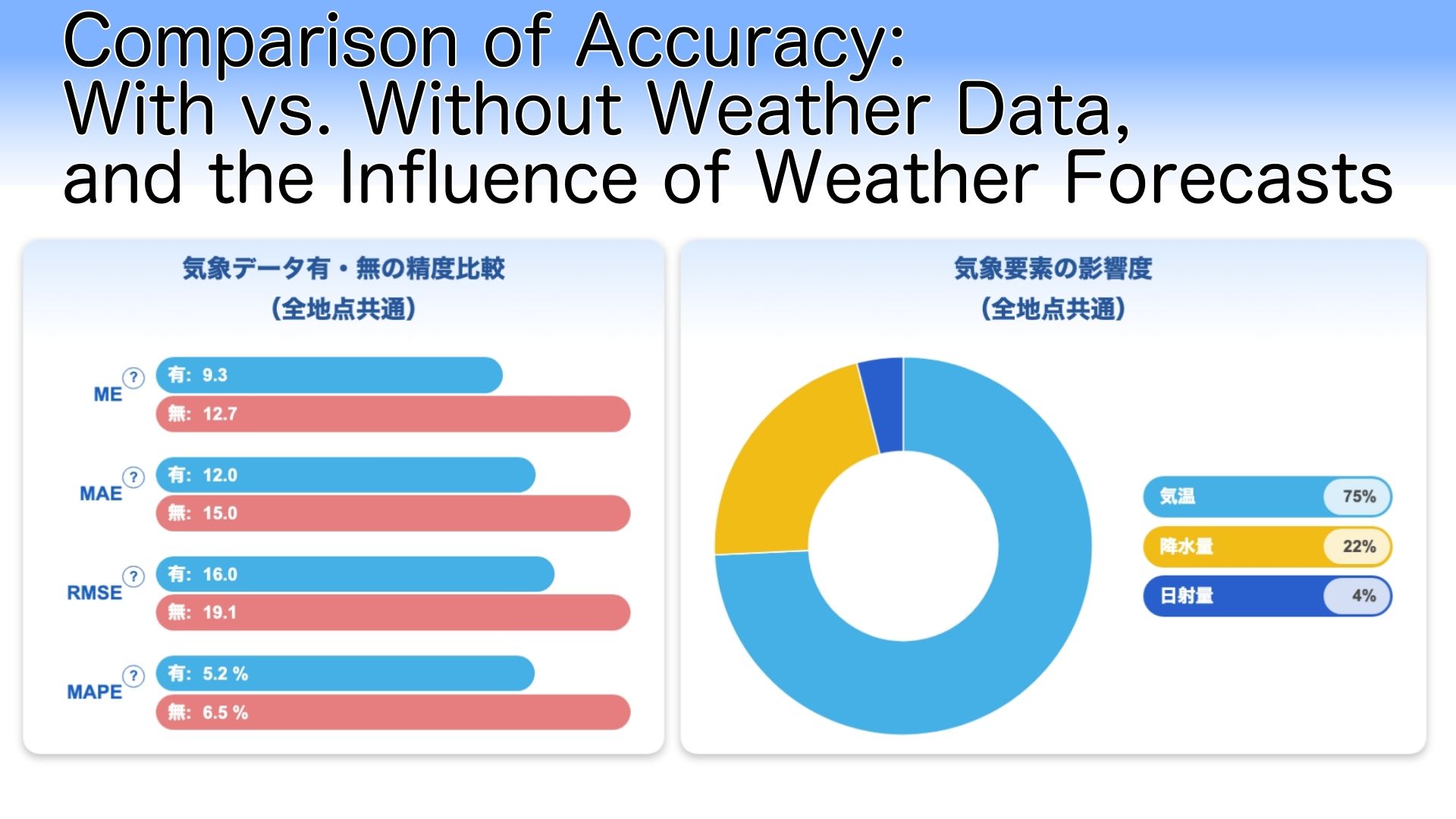
Accuracy Improvement (Left): This chart compares the two AI-generated forecasting models, showing how much your prediction accuracy improves when weather data is incorporated.
Most Influential Weather Factors (Right): This visualization highlights which weather elements have the greatest impact on your business performance.
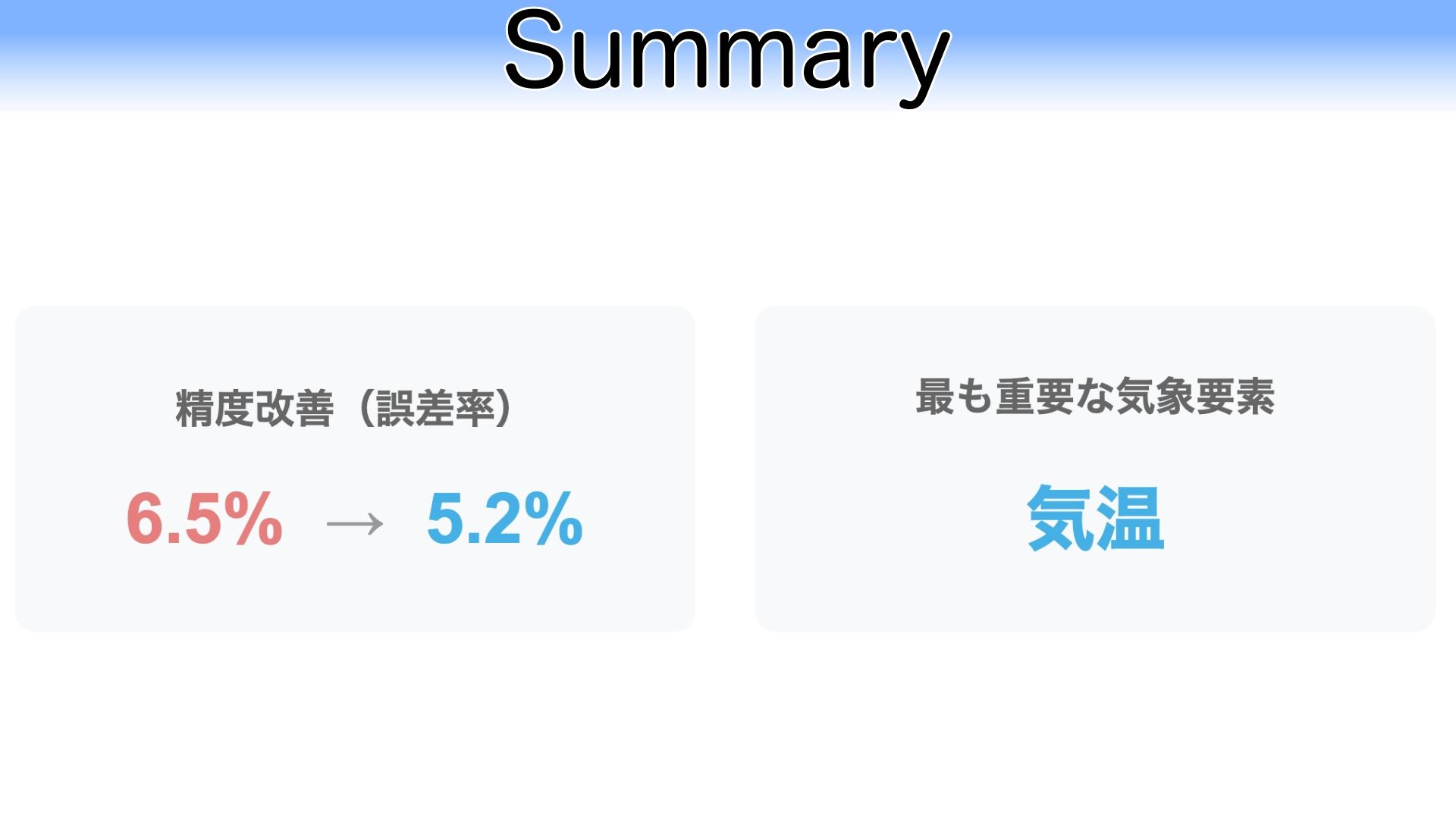
In this example, Model A (calendar-based) has a forecasting error of approximately 6%, while Model B (weather-integrated) reduces that error to around 5%.
This reveals an important insight: the bakery's sales are correlated with temperature, and incorporating weather data delivers measurably better forecasts. In practical terms, this means the bakery can use weather-informed production planning to reduce waste, minimize stockouts, and optimize sales opportunities. For this business, we would strongly recommend adopting weather-based forecasting.
What if there's no correlation? If the analysis finds no meaningful relationship between weather and your business metrics, the comparison simply won't be displayed.
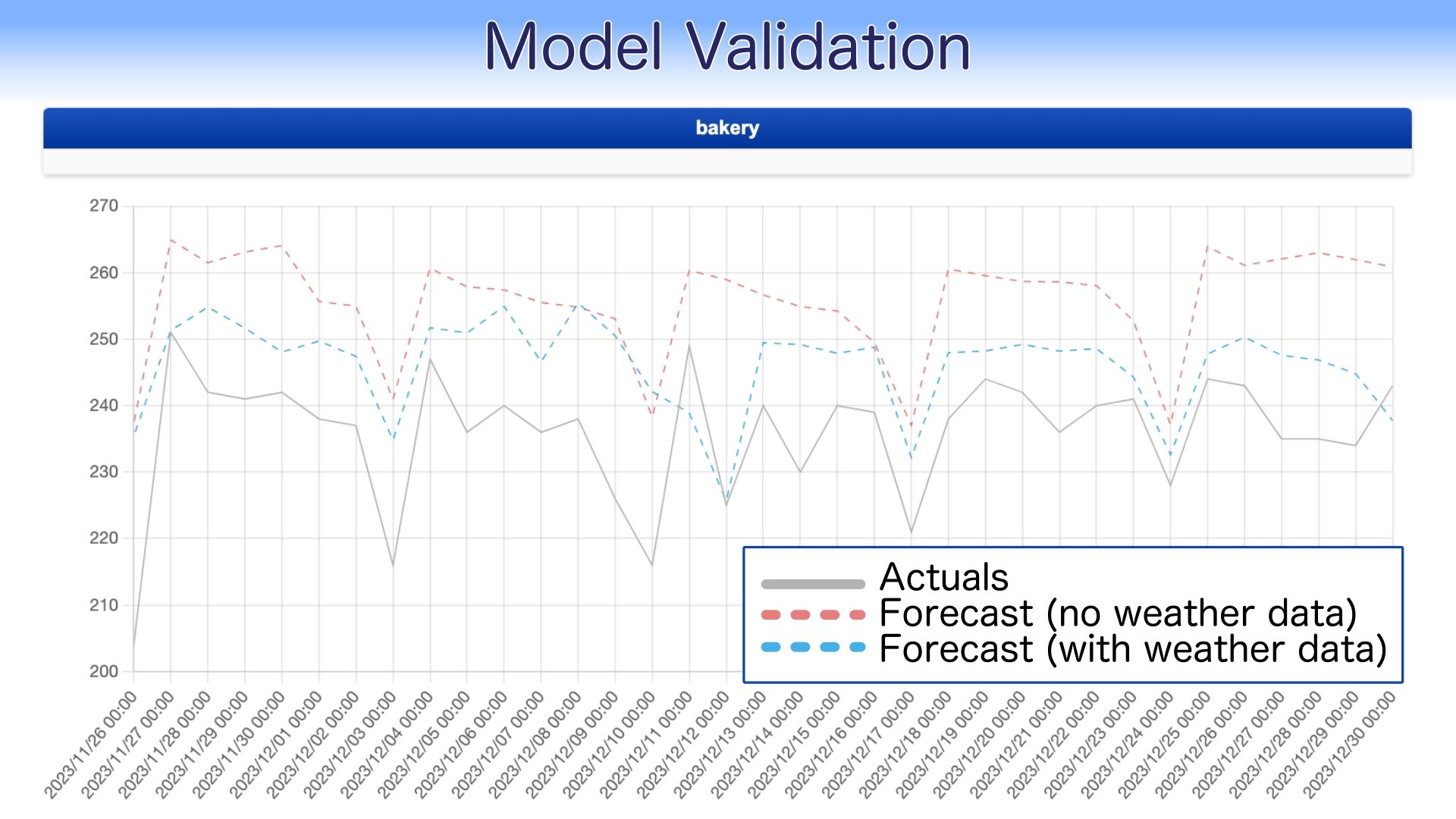
This graph compares the AI-generated forecasts (Models A and B) against actual sales data for September through December 2023—the final 20% of the dataset that the AI hadn't yet seen.
Zooming in reveals a clear pattern: the weather-integrated forecast (blue line) tracks much more closely to actual sales (black line) than the calendar-based model alone.
Want to take it further? If you have your own internal forecasts, compare them against these model results. You might discover that weather-based forecasting offers a significant competitive advantage—or you might find that your current planning process is already highly accurate. Either way, the comparison provides valuable insight into where you stand and where you could improve.
The system analyzes how various weather factors—including temperature, solar radiation, wind, atmospheric pressure, and precipitation—influence bread sales. Results are displayed in order of impact, allowing you to see exactly how much each factor affects your business.
What powers these insights?
These analyses leverage Weathernews' proprietary weather data ecosystem: • A nationwide observation network with 13,000 monitoring points • Crowdsourced weather reports from users across the country • High-resolution forecasting data for pinpoint accuracy
From Intuition to Confidence: How 360 Insight Supports Truly Data-Driven Business Decisions
360 Insight takes the guesswork out of weather planning by clearly demonstrating the difference in forecast accuracy with and without weather data. The benefits become immediately visible. Beyond accuracy improvements, the tool pinpoints which specific weather elements—temperature, humidity, wind, and more—have the greatest impact on your business, giving you strategic intelligence you can act on.
What can you do with these insights? For example:
• Optimize pricing and promotions on days when weather conditions may reduce foot traffic • Fine-tune procurement and inventory ordering to match anticipated demand • Minimize waste and inventory loss through more accurate planning • Improve efficiency across your entire supply chain
We're committed to supporting your business with accurate weather data and demand forecasting capabilities. As we expand globally, we're preparing to make 360 Insight available to businesses worldwide.
We invite you to discover new strategic possibilities with 360 Insight. Try it using your own company data or our sample CSV files, and take your first step toward making weather's impact on your business measurable, predictable, and profitable.
Footnotes
Share

March 13, 2026
How TV Stations Are Transforming Weather Coverage A New Content Solution Helping Broadcasters Navigate Weather and Disaster Reporting
March 6, 2026
Weathernews Launches Comprehensive BCP Service: Emergency Confirmation Powered by Weather Expertise

March 6, 2026
Taking on Japan's Most Widespread Health Challenge with Data and Passion: Why Weathernews Continues to Strengthen Its Pollen Information and the Commitment Behind It